
Business
8 min read

What to Look For in a Full-Cycle Development Partner

Outsourcing is common. Strong tech partnerships aren’t. Our survey of 203 tech leaders shows why: cultural gaps, unclear communication, and hidden costs. Here’s how to use those insights to choose a full-cycle development partner who stays accountable end to end.
Written by
Jonas Greminger
Published on
December 9, 2025
Read time
8 min read

Last year, our team surveyed 203 technology leaders to understand how they approach software development – do they build in-house or work with external partners?

79% said they outsource development. But satisfaction remains low. As a full-cycle development partner that works with DACH enterprises, we wanted to understand why. What goes wrong when companies outsource? What makes the best partnerships?

In this article, we share 6 common concerns tech leaders raised in our survey. We turned them into criteria you can use to choose a full-cycle software development partner – the one who takes responsibility for your product.

First, let’s see what data tells us about how companies approach outsourcing.

TL;DR
Companies worldwide move from task-based outsourcing to full-cycle development, where one team owns planning, delivery, and maintenance (45% to 67% adoption in two years, Deloitte).
Modeso’s survey of 203 tech leaders reveals why traditional outsourcing fails: cultural mismatch, language barriers, data security concerns.
This article provides 6 practical criteria for choosing a tech partner. Each is backed by “what to ask on a first call” points, so you can evaluate vendors with confidence.


The move towards full-cycle software development  

Many software projects that rely on outsourcing end with missed expectations, and our survey confirmed it. Nearly 8 in 10 companies outsource development, yet respondents highlighted six common concerns that make outsourcing harder than it should be (we talk about them in the next section).

Outsourcing itself isn’t the problem. It’s how it’s done. When vendors act as “check-the-box” executors, no one takes full responsibility for how the product performs. That’s why more companies are rethinking traditional outsourcing, preferring outcome-based partnerships instead.

That shift is happening globally, Deloitte’s 2024 Global Outsourcing Survey confirms: 67% of executives already moved from staff augmentation to “outcome-based” or managed outsourcing (this is what we at Modeso call full-cycle development). That’s up from 45% just two years ago.

Note: Outcome-based development (or full-cycle development, as we call it) means you’re not buying hours or extra hands, you’re buying a result. It’s a shared-ownership model, where the vendor runs and manages the whole service, not just executes tasks.


Full-cycle development is still outsourcing, but with shared accountability. One tech partner is responsible for the entire process, from planning and design to development, launch, and maintenance. Companies using this model report higher satisfaction (88%) than those relying on traditional staff augmentation (71%).
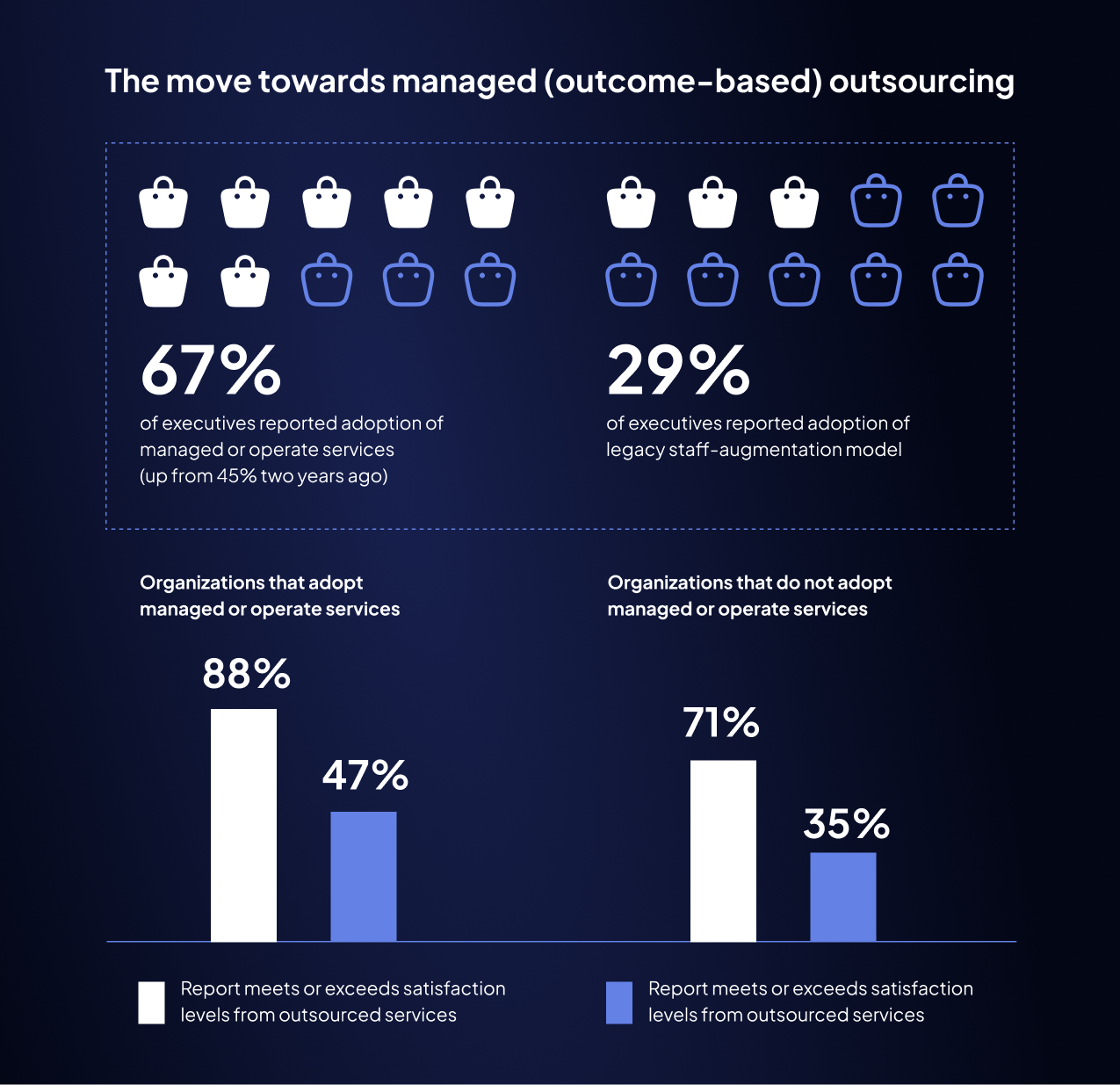
Source: 2024, Global Outsourcing Survey, Deloitte


At Modeso, we see the same shift across the DACH region. Enterprises no longer want extra hands; they want accountability from a partner who owns both the process and outcome.

But what goes wrong in most outsourcing relationships, to begin with?

Our survey of 203 tech leaders revealed six recurring concerns. Each one tells you a lot about how to recognize a true full-cycle development partner.

About our survey
We surveyed 203 technology leaders from companies across:
Switzerland – 56%
Germany – 25%
UK – 13%
Austria, Canada, and others – 6%
Company size:
5,000+ employees – 38%
500–5,000 – 24%
100–500 – 12%
1–100 – 25%
8 in 10 companies (79%) partner with third-party vendors for software development. They choose custom development mainly because:
SaaS tools don’t fit their needs
They want more stability, independence, and control
They see custom software as more cost-efficient long-term


6 things to consider when choosing a tech partner (based on Modeso’s data)

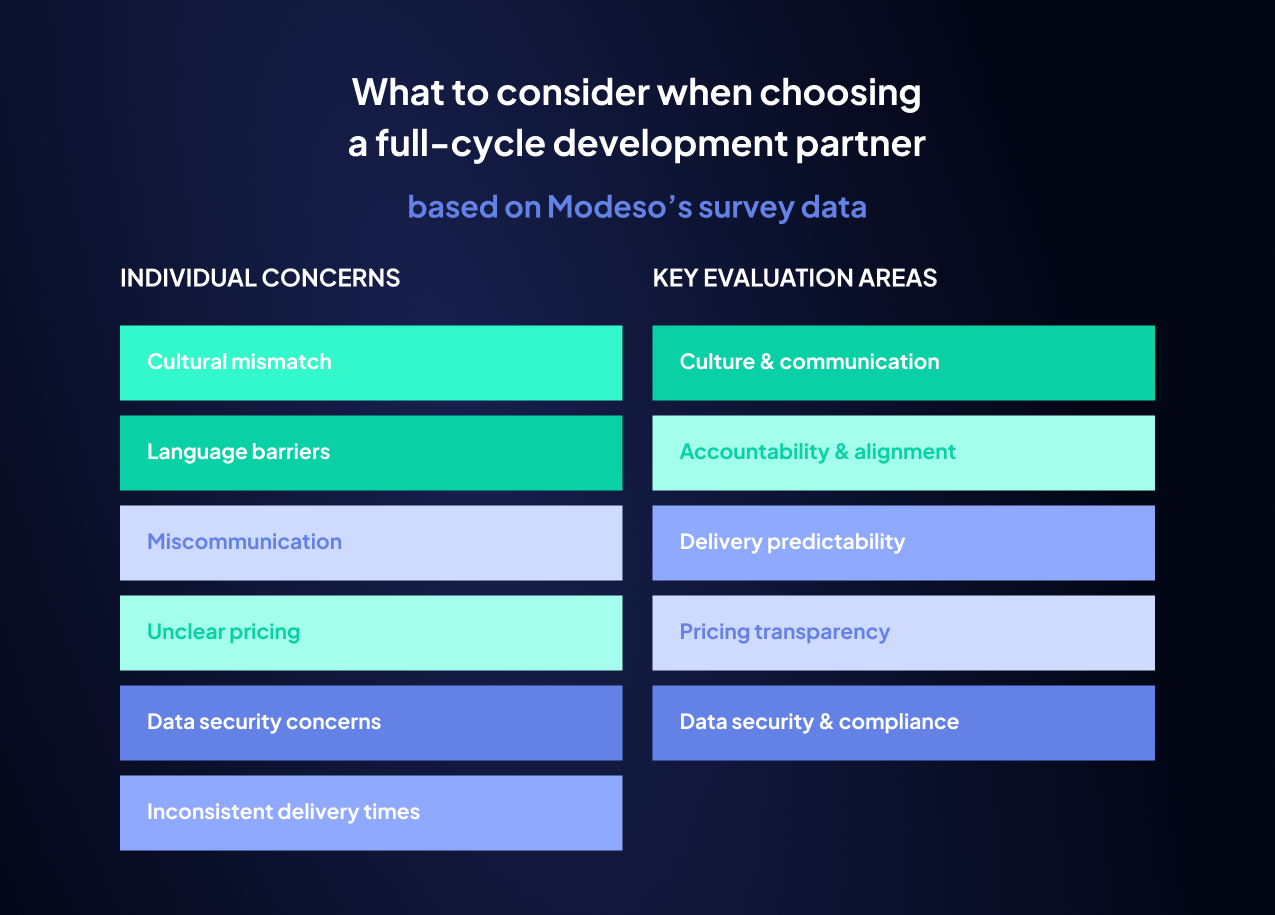
In our survey, respondents highlighted several recurring challenges they face when outsourcing:

  • Cultural mismatch
  • Language barriers
  • Miscommunication
  • Pricing transparency
  • Data security concerns
  • Inconsistent delivery timelines

These concerns cluster into a few clear themes. Based on that, we worked out a list of things for you to consider when choosing a full-cycle software development partner.
1. Shared culture and communication

According to Deloitte, 38% of companies brought work back in-house. Working with teams who didn’t share their communication and cultural habits was too difficult for them. It’s a reminder that collaboration problems don't only come from product quality, but from mismatched ways of working, when even small misunderstandings can turn into real problems. A team might interpret “urgent” differently, hesitate to challenge a client’s decision, or skip context because “the brief was clear.”

“We give priority to local partners: they can be in our offices and communication is easy.”
- Modeso’s survey respondent from Switzerland


Example from Modeso: being based in Switzerland naturally shapes how we work. Our product owners — and most of our clients — are in the DACH region (Germany, Switzerland, Austria). Sharing the same business culture, time zone, and communication habits makes our collaboration faster and more effective.

What to look for in a tech partner:

  • Local or regional delivery leads who join your calls and understand your market
  • Stable communication practices: daily/weekly syncs, sprint reviews, or planning sessions that include both sides
  • Clear documentation habits: shared project trackers, reporting, written summaries after key calls

What to ask on a first call:

  • Where are you based? Who will be our regular point of contact?
  • How will our communication be structured day to day?
  • How do you document project progress?
  • How do you handle misunderstandings or changing requirements across teams?

2. Accountability and alignment

A full-cycle partner stays responsible for whether the product works and creates value. That’s what most outsourcing setups miss. Too often, the client manages goals, while the vendor delivers tasks, and no one owns the result.

“It [outsourcing] can sometimes work but it needs good controls.”
- A survey respondent


Example from Modeso: A project for Albin Kistler AG, a Swiss investment firm managing over CHF 14 billion in assets. We rebuilt their in-house algorithm into a full investment-analytics platform used by their portfolio managers every day. The platform directly supports investment decisions, so we stayed on to maintain performance, fine-tune data accuracy, and extend analytical features as their needs evolved. That ongoing collaboration keeps the tool reliable and valuable for Albin Kistler’s business.

What to look for in a tech partner:

  • A delivery lead/product owner who stays involved from discovery to maintenance
  • Success metrics based on your KPIs (conversion, activation, retention)
  • Teams that stay post-launch to track performance and suggest improvements

What to ask on a first call:

  • How do you define success metrics when starting a new project?
  • Who stays responsible for the project once it moves past the initial phase?
  • Once the product’s live, who stays involved on your side? Do we work with the same team?

3. Delivery predictability

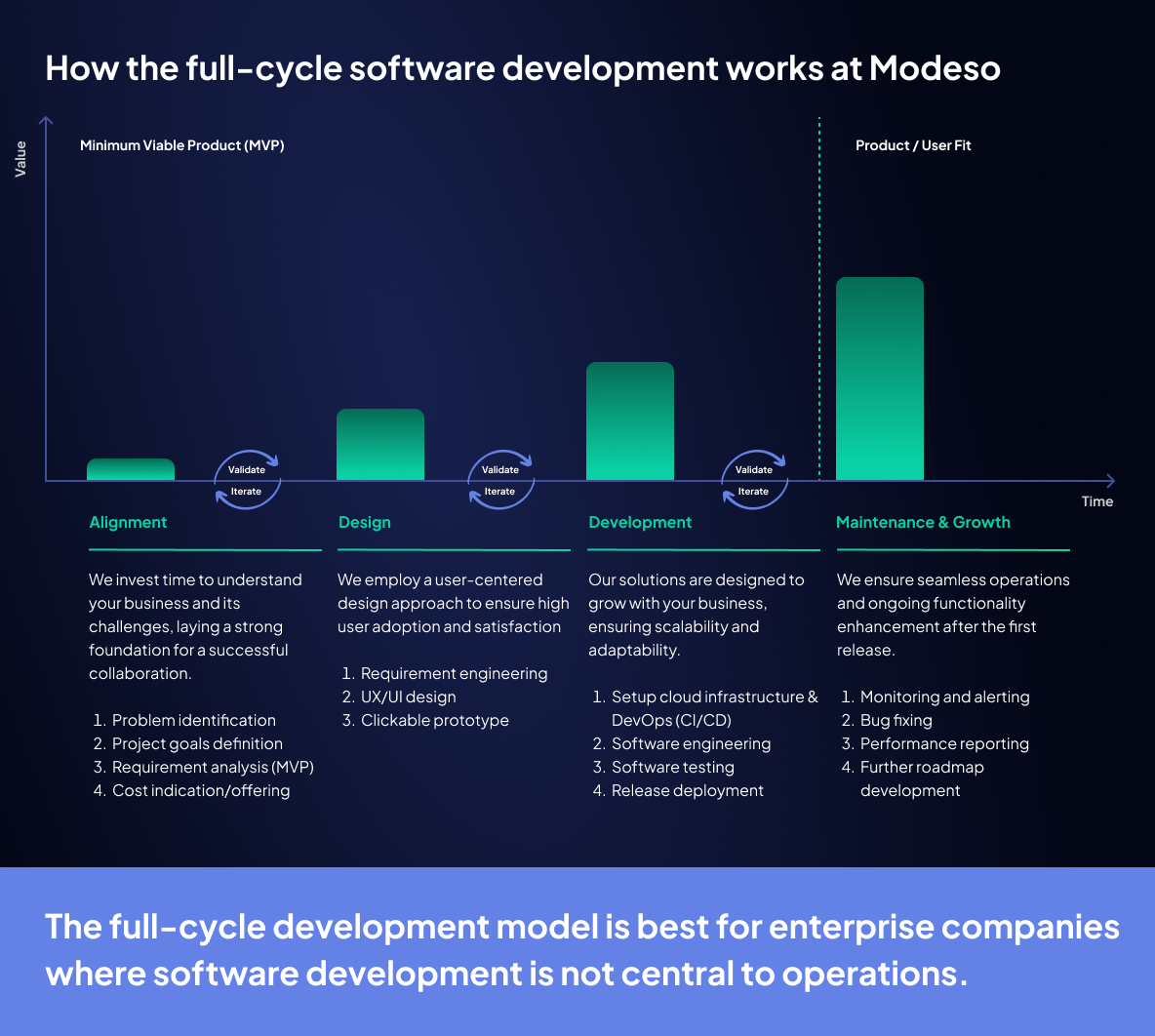
A full-cycle partner stays accountable from planning through post-launch, aligning with you at every step. Still, many companies struggle to get that level of ownership. Per the same Deloitte report, tracking whether vendor work delivers expected results is the main challenge for 55% companies.

Example from Modeso: We use Agile sprints and a Lean mindset to keep our team focused on client’s outcomes. For instance, when working with Visana, one of Switzerland’s leading health insurance providers, we built a mobile-first referral-program MVP in just 2 months. The goal was to test a new customer-acquisition channel quickly, without waiting for full backend integration. So we:

  • focused on the core actions (sending and accepting referrals)
  • used a file-based data exchange instead of a complex API
  • refined and validated user flow via collaborative sessions with Visana

The MVP proved the concept worked and laid the foundation for scaling later, which we also took on.

What to look for in a tech partner:

  • Teams that use iterative delivery cycles with milestones and progress tracking
  • Transparent reporting and demo cadence (weekly/bi-weekly)
  • Realistic scoping and planning (clear estimates, buffers, and early risk flags)
  • A clear delivery framework (Scrum, Kanban, hybrid) that fits your project type

What to ask on a first call:

  • How do you make sure deliverables stay aligned with our business goals?
  • If we realize halfway through that something needs to change, how do you handle that?
  • What does your reporting or demo cadence look like?
  • How do you handle risks or delays when they come up?
  • How often do we get demos or builds during development?

4. Pricing transparency

Cost still matters, but transparency and predictability matter more. The cost-first mindset is fading: companies now prioritize service quality and alignment over short-term savings. Only 34% of organizations list cost reduction as their main reason for outsourcing, down from 70% four years ago. Tech leaders choose transparency over “cheap.”

“Hidden costs and unclear pricing models make it impossible to budget properly.”
- Survey participant from the finance industry


Example from Modeso: We combine Swiss product management with cost-effective development hubs in Egypt. Product ownership, governance and client communication stay in Switzerland, while delivery, QA and DevOps run from our Egypt hubs. This split lets clients in the DACH region benefit from senior oversight and transparent costs at the same time.

What to look for in a tech partner:

  • Breakdown of what’s included in estimates (scope, hours, roles)
  • Predictable pricing models: fixed-scope for MVPs, flexible for ongoing work
  • Shared dashboards or reports tracking spend

What to ask on a first call:

  • How do you estimate new projects? What’s included?
  • How do you keep costs predictable if priorities shift?
  • Who monitors scope and budget on your side?
  • How do you communicate trade-offs between scope, speed, and cost?

5. Data security and compliance

For regulated industries like finance or healthcare, outsourcing often stops at the legal department. The risk feels too high. Data shows that 46% of companies re-insource work to tighten security and compliance controls, one of the top drivers behind reshoring worldwide. So companies choose to work with partners who can meet local compliance standards (GDPR, FINMA, HIPAA) and guarantee where your data lives.

“In regulated business such as insurance, we need to be careful as our data must not leave the country.”
- Survey participant from the insurance industry


Example from Modeso: Most of the companies we work with operate in highly regulated industries: finance (Albin Kistler, TWINT), healthcare (Visana), auditing (Rietmann & Partner). All our client data stays within DACH borders, under Swiss regulatory and security standards. Product ownership and governance stay in Zurich, which keeps all GDPR and Swiss data-protection requirements in check. Our development hubs in Egypt follow the same security processes for access control, documentation, and environment management.

What to look for in a tech partner:

  • A vendor with in-region governance for your regulatory context (e.g., EU/Swiss)
  • Documented data-handling and access-control policies
  • Secure development lifecycle (encryption, code reviews, environment segregation)
  • ISO 27001 or equivalent certification (or demonstrated compliance)

What to ask on a first call:

  • How do you handle data protection and access control across locations?
  • Who is responsible for compliance documentation?
  • Have you worked under GDPR or Swiss data-protection requirements?
  • What’s your process for handling sensitive data in testing and production?

A checklist: How to spot a full-cycle development partner

To recap, when evaluating tech partners, use these questions as your quick filter. If a vendor can answer most of them with clear examples, you’re likely talking to a true full-cycle team.

Culture and communication
Do they work in (or understand) your market and timezone?
How do they keep both sides in sync day-to-day?
What happens when communication breaks down?
Accountability and alignment
How do they define success metrics for a new project?
Who stays responsible for the project once it moves past the initial phase?
Who will maintain the product after launch?
Delivery predictability
How often will you see working software or progress demos?
How do they plan and track milestones?
What’s their approach when priorities or scope change?
How do they handle risks or delays when those come up?
Pricing transparency
Can they clearly explain what’s included in estimates?
How do they manage costs if things shift mid-project?
Who monitors scope and budget on their side?
Data security and compliance
Where will your data live?
Have they worked under your region’s/field’s compliance requirements (GDPR, FINMA, HIPAA)?
How do they ensure documentation and access control?


And if Modeso sounds like a full-cycle development partner you’re open to work with, just drop us a line, and we’ll prepare a project feasibility study so you know exactly what’s what it’ll take.

Get your project feasibility study in 2 weeks

TABLE OF CONTENT
Weekly newsletter
No spam. Just the latest releases and tips, interesting articles, and exclusive interviews in your inbox every week.
Read about our privacy policy.
Thank you! Your submission has been received!
Oops! Something went wrong while submitting the form.
Header image
Preferences

Privacy is important to us, so you have the option of disabling certain types of storage that may not be necessary for the basic functioning of the website. Blocking categories may impact your experience on the website. More information

Accept all cookies

These items are required to enable basic website functionality.

Always active

These items are used to deliver advertising that is more relevant to you and your interests.

These items allow the website to remember choices you make (such as your user name, language, or the region you are in) and provide enhanced, more personal features.

These items help the website operator understand how its website performs, how visitors interact with the site, and whether there may be technical issues.

Thank you! Your submission has been received!
Oops! Something went wrong while submitting the form.