
In other words, the way software gets delivered is the main factor in its success.
When strategy, design, development, and QA belong to different vendors, something breaks at every seam. A vision deck gets handed to a UX agency. Designs get passed to a development house. Builds get thrown at a QA contractor. And somewhere in that chain, your original business objective gets blurry, the timeline expands, and the budget begins absorbing costs no one anticipated.
The antidote to fragmentation is full ownership. At Modeso, we've delivered 90+ products for Swiss institutions, scaleups, and global players thanks to this approach, taking full ownership of every phase. That's what full-cycle software development means in practice: a single team accountable for your product from the first discovery call to the moment a user logs in.
In this article, we break down how our process works step by step, and most importantly, we’ll show you how each step helps you protect your budget and gain ROI faster.
In 2016, the Canadian government launched Phoenix, a payroll system that had to modernize how it paid 300,000 federal employees. The projected cost was $309 million CAD. The projected savings were $78 million per year.
But what followed was nine years of financial chaos. Employees went months without pay. As of 2025, the system has cost taxpayers more than $5.1 billion, and the backlog of unresolved pay errors still runs into the hundreds of thousands.
How could such a failure happen, especially on a governmental level? One of the core reasons was a decision to separate human resources and payroll, two functions that were never designed to operate in silos. They were handed off between IBM, internal teams, and oversight bodies, who each saw only their part of the system, never the whole.
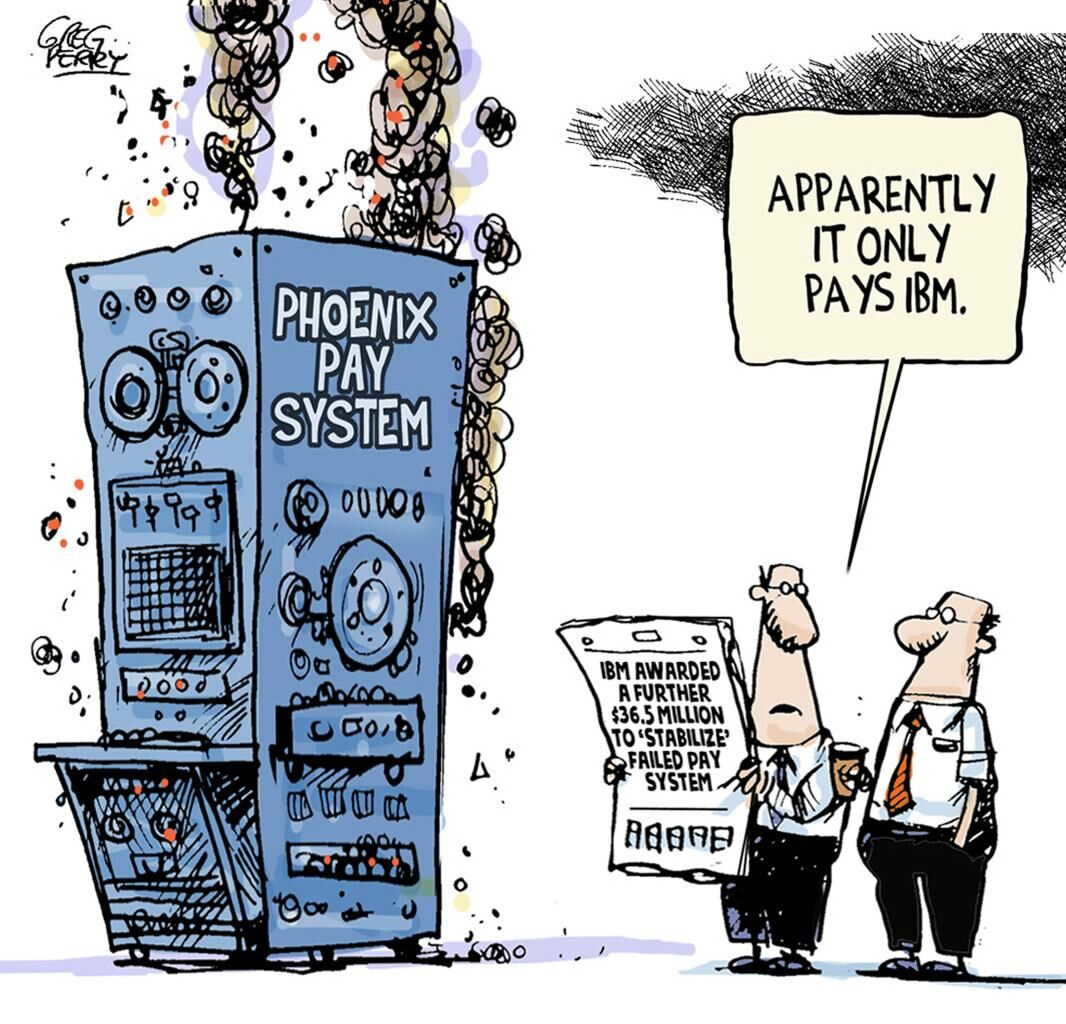
Phoenix is an extreme case. But the underlying failure pattern they present is not.
BCG found that the failure to align on business outcomes is the single most cited reason projects go over budget and over time, across 25 industries.
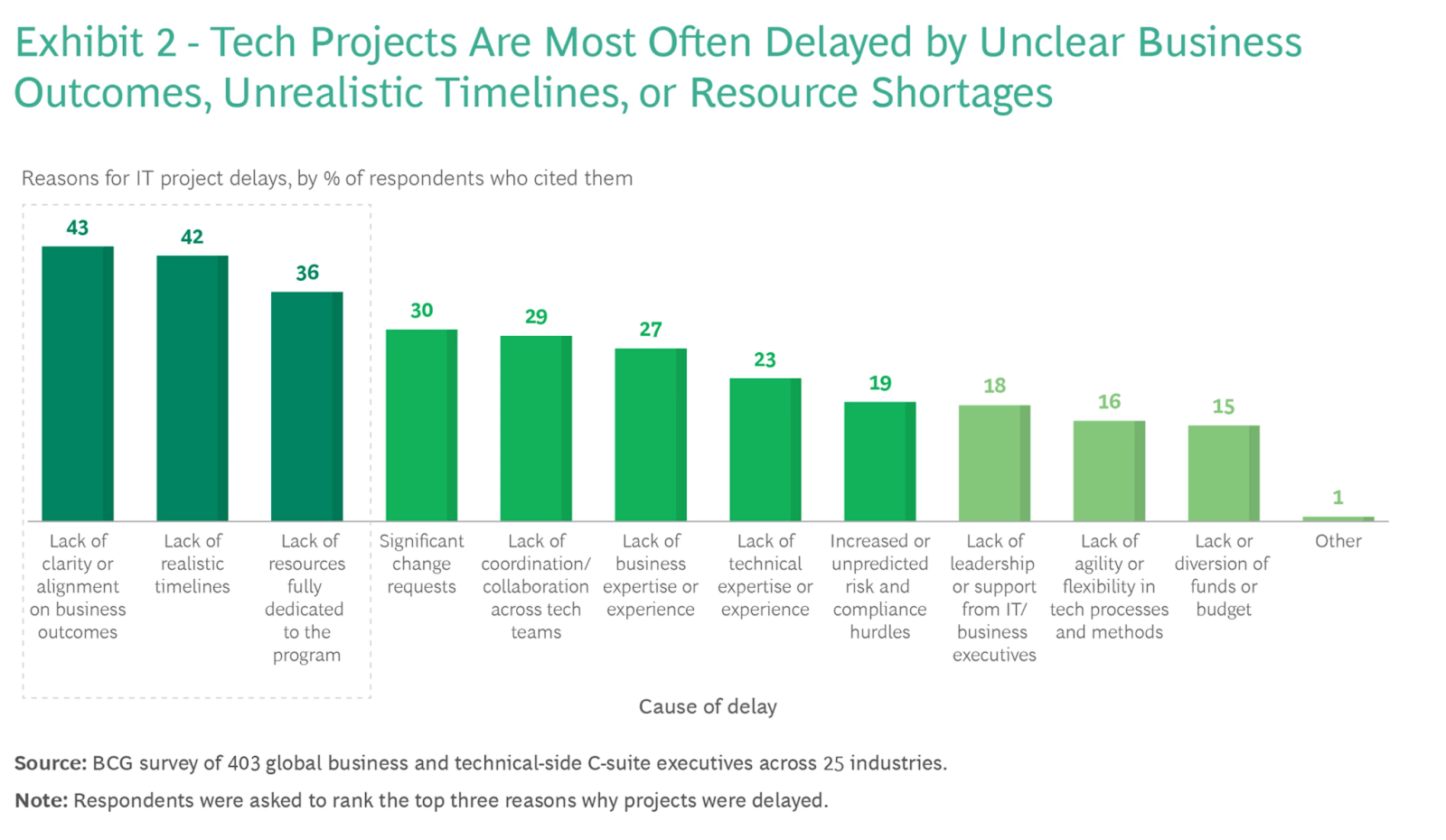
This is the hidden cost of the multi-vendor model. Every time context moves between teams, some of it gets lost. Every time ownership changes hands, accountability diffuses. The delay doesn't show up as a line item, but it's there, absorbed quietly into your timeline and your budget.
Too often, the development process looks like this: Consulting firm → UX agency → Dev vendor → Internal IT → External support.
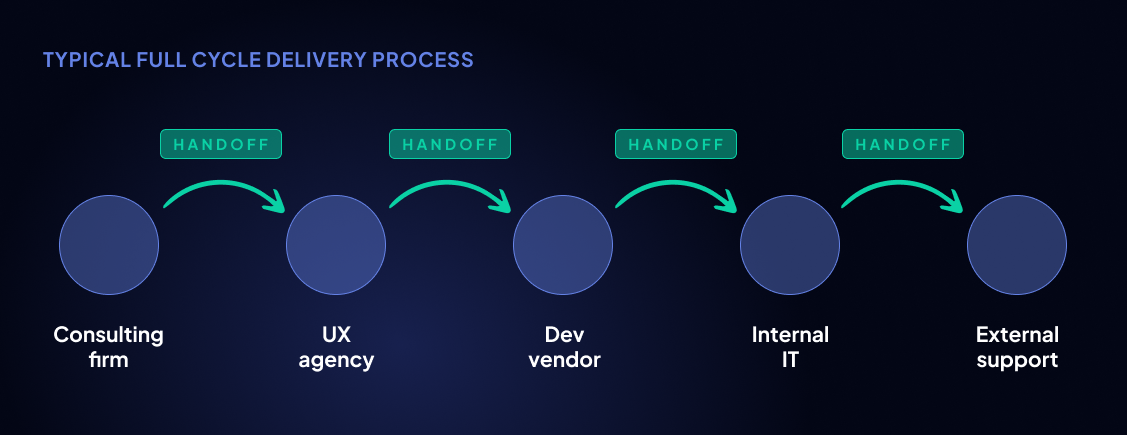
Each of those vendors is competent in isolation. And yet somehow, the final product is late, over budget, and not quite what was intended.
The reason goes deeper than missed deadlines. Every handoff quietly reshapes your cost trajectory through rework, accumulating technical debt, and coordination overhead.
Read also: Why You Can't Calculate ROI of Custom Software Development.
Full-cycle development eliminates the structural delivery risk. It's about having one team that holds the full context from strategy through to deployment. That's the model Modeso is built around, but let’s compare it to other models and how they work in practice.
Over the past decade, companies have experimented with different structural models in search of speed, flexibility, or cost efficiency. Some prioritize access to niche expertise, while others optimize for control. But very few are designed around one question:
Where does delivery risk accumulate?
Below is a quick comparison of the most common software delivery models and how they shape cost trajectory, accountability, and long-term scalability.
In the multi-vendor model, strategy, design, development, QA, and maintenance are split across different partners. A consulting firm defines the vision, a UX agency designs it, a dev vendor builds it, QA may be outsourced separately, and post-launch support often changes hands repeatedly.
On paper, this promises specialization. In reality, it creates translation layers: context gets compressed at every handoff, assumptions slip in, and accountability diffuses. The issue often lies in structural seams because of which timelines stretch, rework grows, and “who owns the fix” becomes unclear.
An in-house team gives you maximum control over roadmap, priorities, and technical direction. Knowledge stays inside the organization, and for core platforms or strategic IP, that control can be a real advantage.
The tradeoff is that cost and complexity are frontloaded with recruitment, onboarding, retention, and management happening before value is validated. Skill gaps also appear in predictable places (architecture, security, compliance, DevOps), and scaling becomes slow and expensive, which is why this model works best when software is your primary business capability.
A dedicated team is an external team working exclusively on your product, often integrated into your workflows. It reduces hiring burden, adds capacity fast, and lets you scale up or down without building a large internal org.
Structurally, though, product ownership and delivery accountability often remain on the client side. As an outcome, if alignment is weak or scope shifts midstream, the “delivery risk” becomes a shared responsibility between the client and vendor that can slow decisions and inflate coordination overhead.
Full-cycle development is organized around continuity: one accountable team owns the lifecycle from alignment to maintenance and growth. Instead of handing work between parties, the people defining the MVP are connected to the people building it, testing it, securing it, and supporting it after launch.
This structure reduces the usual failure points. QA and security are embedded from sprint one, and post-launch work doesn’t start with re-learning the codebase. Full-cycle won’t remove complexity, but it does remove the fragmentation that typically drives rework and slowdowns in regulated environments, complex integrations, and scaling platforms.
With that covered, let’s now see how our company approaches full-cycle development.
Every phase in our process has one job: eliminate a specific category of risk before it reaches the next stage. The team that runs your alignment workshop is connected to the developers, the QA engineers, and the people maintaining your system after launch.
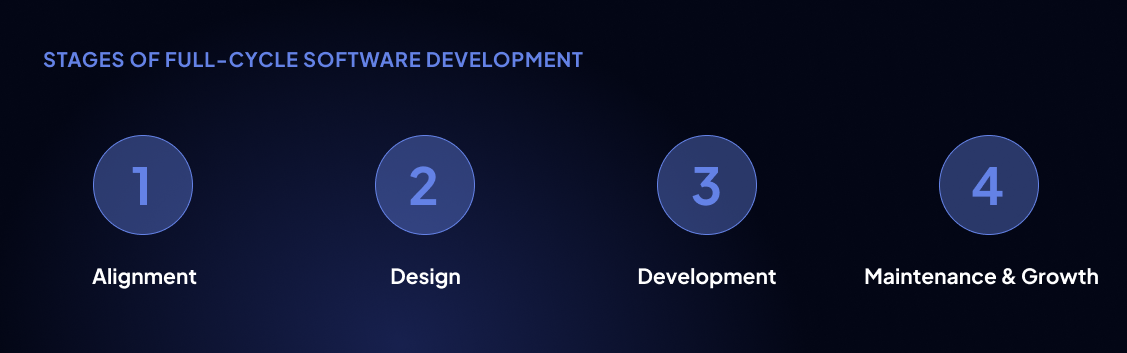
Before we walk through each phase, one note: the process only works if the partner running it is the right one. Our survey of 203 tech leaders shows that cultural gaps, unclear communication, and hidden costs are the most common reasons full-cycle partnerships fail in practice. Now let’s see how the full-cycle process works in practice.
Read also: What to Look For in a Full-Cycle Development Partner
In fragmented delivery, alignment is a kickoff meeting. The consulting firm hands a vision deck to the UX agency, and by the time a developer reads the brief, it's passed through at least two interpretations nobody validated.
At Modeso, we treat alignment as the riskiest phase of the project because the decisions made here determine whether every dollar spent afterward goes in the right direction.
This means we start with the business problem. What is broken, what is slow, what does success look like twelve months after launch? From there, the team works backward to define the MVP.
In the Swiss market specifically, this phase also covers compliance. FADP, GDPR, and sector-specific constraints are not details to address later.
The best way to show the price of the right alignment phase would be to illustrate it with a real case.
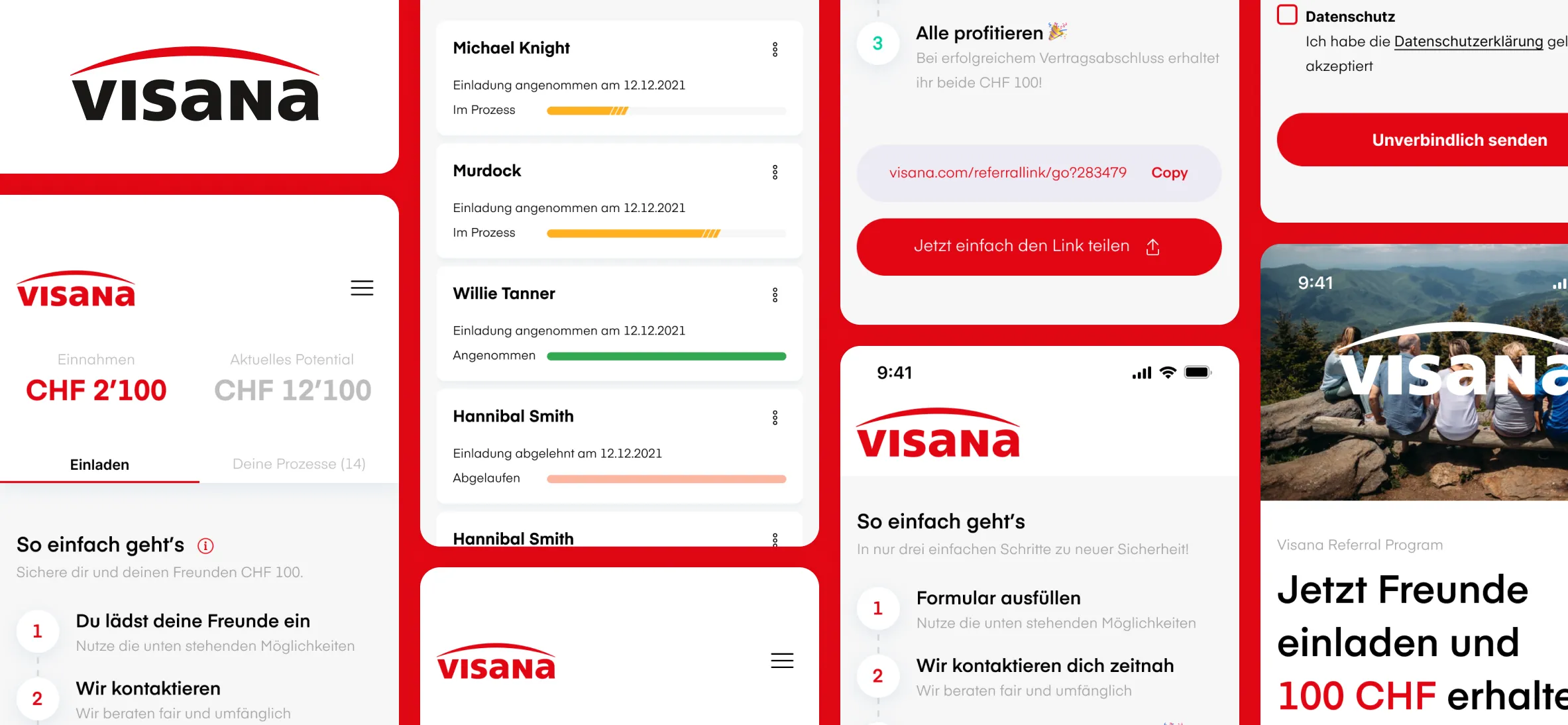
When Visana, one of Switzerland's largest health insurers, came to Modeso with an idea for a customer referral program, we first had to validate the concept without overbuilding.
A couple of meetings were enough to align on user flows, define the MVP boundaries, and agree that a file-based data exchange would be the right call for this stage. It was faster, cheaper, and came with fewer risks for a product that hadn't yet been proven with customers.
That scoping decision allowed the team to deliver a working MVP in just two months. Visana validated the concept, then asked Modeso to replicate the solution for a partner organization. The foundation was solid because the constraints were agreed on before a single screen was designed.
That's the difference between an alignment phase and a kickoff meeting.
Most products fail because they were built for a user that doesn't exist, or a workflow that was assumed rather than observed. By the time that becomes clear, the cost of fixing it is too high.
Modeso's design phase runs differently because the designers are directly connected to developers. Requirements get documented as testable specifications, and prototypes get put in front of users before the architecture is decided.
A flow change at the wireframe stage takes an afternoon. To compare, the same change after development takes weeks and costs much more.
To show you how we approach this stage in practice, here’s the story of how we designed our own financial reporting platform for accountants.
We started Aumico, a financial reporting platform for accountants, with a thin prototype: import Excel data, generate a PDF.
What came back from testing wasn't what anyone predicted. Users could live with rough edges in the interface. What they wouldn't accept was a single misaligned element in the final report. That insight, invisible until a real accountant sat down with a document, restructured the entire design priority list.
From there, we added only what users asked for:
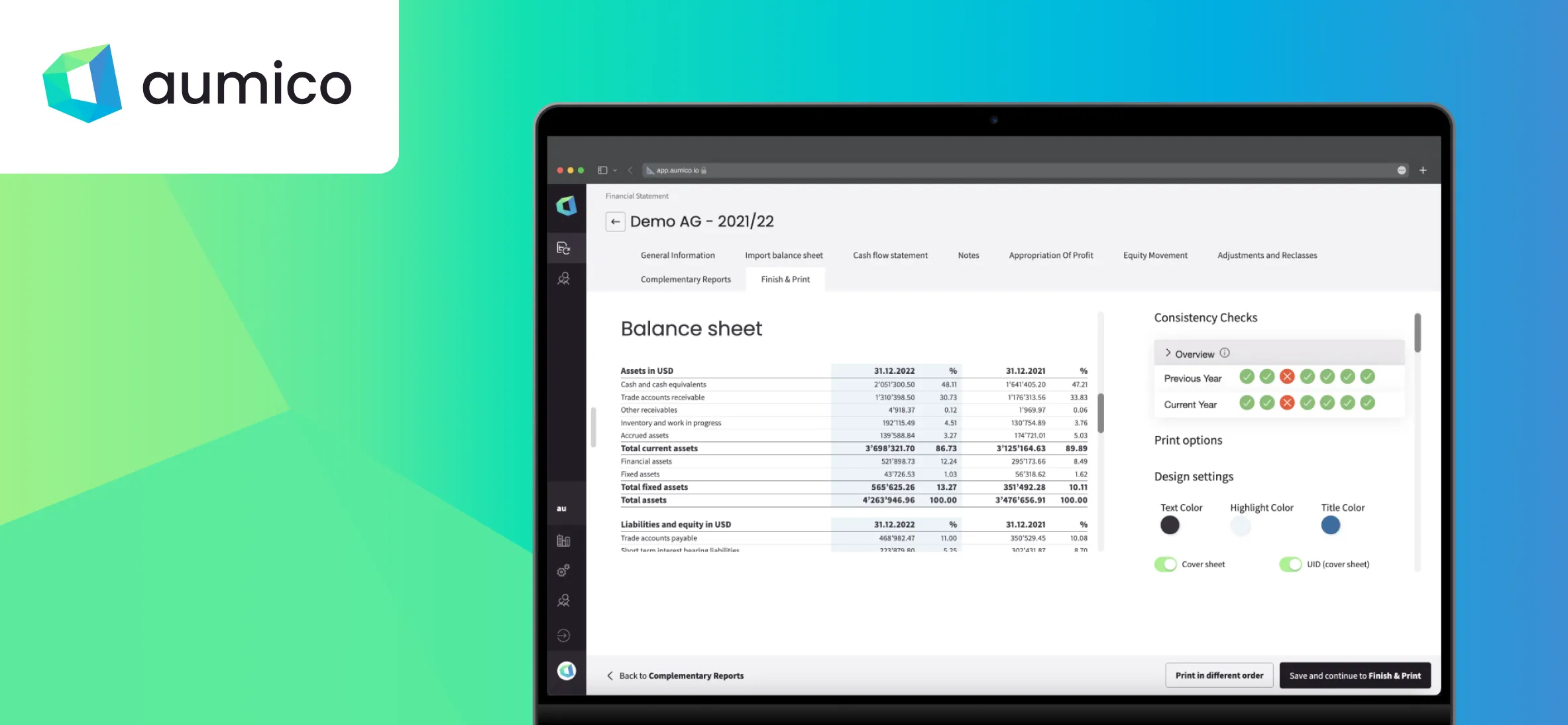
The result: 4,000 recurring licenses in two years. Without that initial design stage guided by real feedback, we wouldn't be able to release a product the market needed.
Even when alignment is solid and design is validated, development is where new risk is born. Requirements evolve mid-sprint, a third-party API behaves differently in production than in testing, and a new feature has edge cases nobody anticipated. This is normal, and the question isn't whether these situations will arise, but how fast your team can catch and resolve them.
In fragmented delivery, the answer is: slowly. QA is a separate team that joins late, security is reviewed before launch rather than built in, and every unexpected issue triggers more delays.
At Modeso, development runs in short, tested increments with QA embedded throughout. The same team that ran alignment and design is writing the code, which means no context is lost in translation. Security, compliance, and performance are built in from the first sprint.
Here’s how our development approach helped TWINT scale to millions of users.
TWINT, Switzerland's dominant mobile payment app, was looking to expand into a full digital marketplace and brought Modeso in as a technology partner.
TWINT didn't need a vendor to write code. They needed a team that could ship production-grade features inside a banking app used daily by half of Switzerland.
We built security and QA in from the first line of code. Every module went through independent penetration testing, we load-tested each one to 150,000+ orders per hour, and deployed everything on GCP with Kubernetes autoscaling.
Since 2020, Modeso has shipped five marketplace modules inside the TWINT app:
Five years on, the same partnership is still running and expanding. That's what happens when you build the architecture with a growth plan rather than just to ship.
Launch day is where most vendor relationships end. It's also where the most expensive problems begin.
In fragmented delivery models, post-launch is an organizational gap. The agency that built the product has moved on, documentation is partial, and the internal IT team inherits a codebase they didn't write, with dependencies they don't fully understand. Every time something breaks or needs to evolve, the knowledge has to be reconstructed from scratch.
At Modeso, the team that built the product stays with it. That means new features don't require re-onboarding a team to a codebase they've never seen. And the roadmap can move because the people developing it understand what's already there.
Here’s how this approach worked for one of our clients.
Modeso helped Dental Axess launch Xflow, a data platform where orthodontic professionals could manage information about the clear aligner manufacturing process.
But after launch, it grew into something more valuable: a workflow management system that handles the entire supply chain, integrates with scanners, AI design tools, laser cutters, and external manufacturers, and operates across regulatory environments in Europe, Australia, New Zealand, and North America.

None of that happened at launch. We kept working on the platform, learning the industry, and building the next layer of functionality.
When AI-assisted 3D scan refinement became possible, the same engineers who built the original architecture implemented it.
As a result, the platform now automates almost the entire clear aligner manufacturing workflow. That kind of outcome doesn't come from a maintenance contract. It comes from a team that never stopped treating the product as their own.
If structure determines delivery risk, how do you know it’s working? Four signals tend to matter most:
Productivity shows up in predictable delivery cadence. Quality can be tracked in defect rates and post-release incidents. Efficiency reveals through how quickly decisions turn into shipped changes, without coordination overhead eating the timeline. Customer satisfaction closes the loop through adoption, feedback, and retention.
These metrics improve when the delivery system itself supports them, when releases are small and testable, if feedback loops are short, and when security and monitoring are part of everyday development rather than separate events. That’s where the software development life cycle and DevOps practices play a vital role.
Full-cycle development maps cleanly onto the SDLC from alignment to design and development and then finally to maintenance and growth. And this is where a lot of projects quietly go sideways.
At Modeso, our continuity is supported by DevOps from the first sprint. Infrastructure is set up alongside the application, CI/CD pipelines are established early, and automated testing runs continuously as features are built. Releases move in small, tested increments rather than large, high-risk drops. Progress isn’t measured by slide decks — it’s visible in working software, performance metrics, and documented sprint outcomes.
Security follows the same principle. Instead of being introduced as a late audit, security checks are integrated into the delivery pipeline through DevSecOps practices such as automated code analysis and vulnerability scanning. Monitoring, alerting, and post-release reporting remain part of the same lifecycle, handled by the team that built the system. That structure keeps collaboration tight, risk visible, and long-term resource planning grounded in real operational data rather than assumptions.
After enough failed projects, the instinct is to add something. A new project management platform, a specialist vendor, or a dedicated QA partner. Each addition feels like a fix, and each one adds another seam where risk quietly accumulates.
But what if the problem was never the tools but the structure?
When strategy, design, engineering, QA, and maintenance are owned by different teams with different incentives and definitions of done, no framework holds them together well enough. The gaps between them will exist, budgets will disappear, and timelines expand.
Full-cycle development is a structural answer to a structural problem. One team, one context, one set of people accountable for the outcome from the first conversation to the last deployment.
If you are looking for a full-cycle development partner who can deliver what you need without hiccups, Modeso can help. Contact us, and we’ll get back to you ASAP to see what we can do for you.

Privacy is important to us, so you have the option of disabling certain types of storage that may not be necessary for the basic functioning of the website. Blocking categories may impact your experience on the website. More information


