
"What is the ROI?"
I hear this question at least twice a week.
Truth is, most ROI calculations in software development are fiction.
And the reason for that is because many people are not measuring costs that come after initial development.
So further, I’m not going to just give you a generic ROI formula. I'm going to show you:
To talk about ROI honestly, I’ll start by breaking down what “software cost” actually includes outside the build phase.
Most ROI calculators treat “development cost” as the invoice you paid to ship the first version of the solution. The real spend shows up in everything around the code: architecture choices, QA discipline, DevOps, compliance, and the post-launch work that keeps the product stable and evolving.
This is where full-cycle development looks more expensive if you compare it to coding hours. But note that you’re buying the whole delivery ecosystem upfront, so the inevitable costs don’t come back later as crises, not hours solely.
→ Read also: The cost of full-cycle development
Infrastructure is the “everything works in real life” layer: environments, hosting, deployments, monitoring, scalability foundations, and the boring but expensive parts like security and compliance. Defer architecture and infrastructure decisions, and you invite emergency rewrites when usage grows or integrations pile up.
In a full-cycle setup, these requirements are typically priced upfront as part of the delivery commitment, because the same team will have to operate what they ship.
Again, QA is more just “a QA engineer on the team.” QA is mainly about catching defects early before they leak into production and turn into downtime, urgent hotfixes, and unpredictable support work. Push QA to the end, and the project starts paying “after-launch interest” on decisions that looked like savings at the time.
Full-cycle teams reduce this risk by integrating QA systematically from day one, because they own the outcome and not just the sprint output.
Maintenance is where ROI either compounds or collapses. After launch, you’re paying for bug fixes, small adjustments, monitoring, reliability work, and the constant stream of “can we change this?” requests that every living product generates. In fragmented delivery, the cost can become unpredictable, because the people who built the system are gone, and every change starts with rediscovery.
Full-cycle, on the other hand, offers a defined support period into the model (fixes, minor improvements, and the handover mechanics), which makes this cost visible instead of “surprise work” six months later.
Training and documentation is the cost of keeping context inside the product, and not inside someone’s head. Without clear documentation and knowledge transfer, every new developer or internal hire has to reverse-engineer why decisions were made, creating additional overhead costs.
In full-cycle, documentation and knowledge transfer are typically treated as part of the lifecycle responsibility (because the same team must maintain and eventually hand over what they built). As a result, you’re not paying for “extra discovery” every time the product changes hands.
If you google "ROI of custom software development," you'll find dozens of articles, each with some variation of:
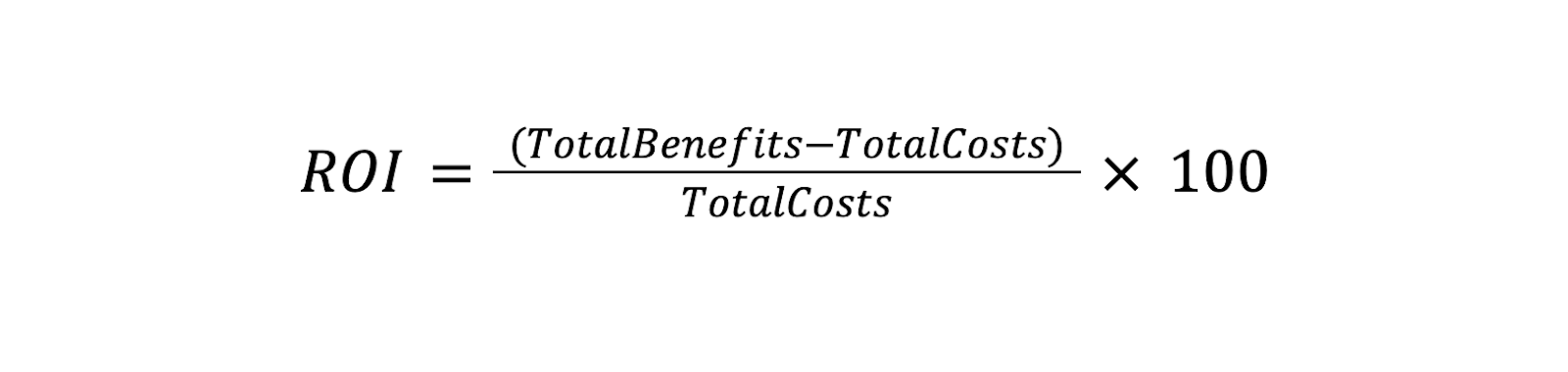
They'll tell you to:
I've seen this formula in dozens of RFPs. I've also watched prospects fill out elaborate spreadsheets with projected costs and benefits, trying to justify a €200K investment in a custom software to their CFO.
But here's what those spreadsheets don't account for:
So is there anything wrong with the formula? No, if you already know your costs and benefits. But in software development, those numbers don't exist until 18-24 months after you've committed.
So where do those hidden costs actually come from? Usually, from how most companies approach outsourcing software development.
Most software projects don't start with one vendor. They evolve:
This is what we at Modeso call fragmented delivery.
The approach seems logical: hire experts for each phase, avoid vendor lock-in, maintain negotiating power.
Yet, the “multiple-vendor” approach creates costs that don't appear in anyone's proposal. Three types, specifically.
Decades-old research from Dr. Barry Boehm, computer science researcher, shows that fixing defects gets exponentially more expensive as they move through the development lifecycle. While the exact multipliers (5x, 10x, 50x) came from the 1980s Waterfall projects, the underlying principle remains true: later is more expensive.

With multiple parties handling your software, this principle becomes more extreme:
Once context is lost and no one owns the long-term, technical debt accumulates in the codebase. Code becomes harder to understand and shortcuts pile up.
As technical debt accumulates, development velocity slows. Ken Rubin's research on Scrum teams shows that 'the greater the debt today, the slower the velocity tomorrow': features that once took days now take weeks.
By coordination I mean the time and mental energy spent managing multiple parties.
Research from the National Research Council on software teams proves that coordination costs multiply – each new vendor creates more coordination work than the last. This cost doesn't appear on any invoice. But it's real hours you're spending that could go toward, say, product strategy.
Traditional ROI formulas assume you can predict costs upfront. But the three hidden ones we just covered – rework, increasing feature costs, coordination – don't appear in any vendor's initial proposal. They emerge later, from the gaps between parties.
So, if fragmented delivery creates these hidden costs, what's the alternative?
Amazon pioneered what Jeff Bezos calls "two-pizza teams": small autonomous groups, each owning a service end-to-end. Werner Vogels, Amazon's CTO, formalized this into the principle "You Build It, You Run It": the team that builds a service operates it in production.
The same logic applies to full-cycle development in software outsourcing. It's gaining traction globally. Deloitte’s survey found that 67% of organizations already moved from staff augmentation to “outcome-based” or managed outsourcing (what full-cycle is). That’s up from 45% just two years ago.

What full-cycle means: One vendor owns your product from conception through maintenance. It's not just about having one vendor, but having one party accountable for the total outcome over time.
→ Read also: What to look for in a full-cycle development partner
But here's what changes: ROI is no longer a post-launch calculation.
In fragmented delivery, you measure ROI once: "Did we get what we paid for?" Full-cycle shifts this to an ongoing question: "Is the product becoming more valuable and less expensive to evolve?"
ROI becomes the accumulated result across discovery, architecture, delivery, and long-term scaling.

When one party owns the entire development lifecycle, they:
What this means for you: The vendor doesn't optimize for finishing a contract and moving on. They optimize for long-term maintainability because they'll be the ones maintaining it. Development gets cheaper over time because they're working with their own architecture and don’t bill hours for discovery.
In 2016, Philipp Osterwalder switched jobs: from a pharmaceutical lab to a food and beverage testing facility. The pharma lab ran automated quality control. The food lab used paper checklists and Excel spreadsheets. Every test required manual documentation.
Labs paid €100,000 for enterprise lab information management software (LIMS), or they didn't automate at all. Philipp, a biomedical analyst with no tech background, saw a gap between what labs needed and what they could afford.
The team at Modeso turned his rough idea into a clickable prototype in six months and showed it to Swiss companies. Five became paying customers. Then we kept building: same team, same architecture. The core module first (sample management), then task management, analytics, ERP integrations. Years later, AI-powered features.
Our team grew from 3 engineers to 13 people: business analysts, designers, product owners. Today, 1LIMS serves 70+ labs worldwide.
Here's what possibly could have happened instead:
One vendor builds the prototype. Six months later, Philipp wants a new feature. He hires a new vendor because the original one's unavailable. They need weeks for discovery – billable hours before any actual work starts. Year two: maintenance shop says "the previous code needs refactoring before we can add anything." More billable hours. Year three: AI features? "The architecture doesn't support this without significant rework."
Each handoff adds discovery time, each new team adds rework costs, and Philipp never knows if he's paying for progress or paying to fix what was already "finished."
What actually happened:
Same team from day one. Feature costs decreased over time because we already knew the system. When Philipp wanted something new, we could tell him: "This will cost X and take Y months."
That's a predictable ROI. Not necessarily cheaper, but knowable. Philipp could plan. He could make informed decisions about where to invest next because costs traced directly to outcomes, not to fixing what the previous vendor built badly.
If you answer "yes" to 2 or more, full-cycle development approach will work for you:
Why it matters for ROI: Every handoff between vendors costs you context, knowledge, and architectural decisions that compound over time. The longer the product lives, the more expensive those handoffs become.
Why it matters for ROI: Coordination overhead is a hidden cost. If you're spending 20% of your time managing vendor handoffs, that's 20% of your salary in the ROI equation.
Why it matters for ROI: Full-cycle vendors can pivot quickly based on user feedback because they own the architecture. With fragmented delivery, changes mean renegotiating scopes and contracts. It slows learning and increases the cost of iteration.
You can't predict ROI if you can't predict costs. And you can't predict costs when rework, technical debt, and coordination overhead hide in the gaps between vendors.
The choice between fragmented delivery and full-cycle isn't about "vendor lock-in" versus "flexibility." As shown in this article, your choice directly affects ROI predictability.
Fragmented delivery works when you have short timelines, strong tech leadership, and well-defined requirements. Full-cycle works when your product will evolve, you need cost predictability, and architectural decisions compound over years.
The three questions above give you a framework. But if you're still weighing the options, we built a quick assessment to help you figure out which approach fits your situation.
Our team at Modeso developed a 2-minute assessment to help you figure out which delivery approach fits your situation, and what it'll likely cost over years.

Privacy is important to us, so you have the option of disabling certain types of storage that may not be necessary for the basic functioning of the website. Blocking categories may impact your experience on the website. More information


