
Every enterprise software project starts with a plan. A surprising number of them, however, end somewhere far off the mark because ownership was split across too many parties. This is the default outcome of fragmented software engagement.
For DACH enterprises, it means more than missed deadlines or budget overruns. It creates operational risk, weak ownership, and costly compliance gaps. GDPR fines, for instance, can reach up to €20 million or 4% of a company’s annual global turnover, whichever is higher.
Full-cycle software development can prevent that. But only when you work with a vendor who does it right.
Modeso has built and maintained business-critical systems for DACH enterprises for over 13 years with a single operating principle: one partner owns the outcome from the first requirements workshop to long-term maintenance. Further, we’ll show you how full-cycle development should work, so you can avoid the accountability gaps and handoff failures in the future.
Large enterprises often work with fragmented vendors despite the risks. Is it a result of poor planning? It’s not. It’s the natural output of how complex organizations procure software.
Enterprise departments are built around functions. IT owns infrastructure. Procurement manages vendor relationships. Compliance reviews at the end. Operations inherits what's delivered. Each department engages the vendor relevant to their phase and passes responsibility to the next.
The build-or-buy question makes things even messier. Based on Modeso’s survey of 200 technology leaders, 44% end up doing both: using off-the-shelf tools in some areas and building custom systems in others. The result is a patchwork of platforms, vendors, and responsibilities. No one planned for accountability gaps, but the setup creates them anyway. The only question is when they surface and how much they cost when they do.
And they always surface the same way – at the handoff.
We often blame software project failure on missed deadlines or scope creep. But those are symptoms. The real problem starts with a handoff.
Let’s look at a typical engagement model for an enterprise software initiative: a consultancy defines the requirements, a development agency builds the product, an internal IT team takes over deployment, and post-launch support lands with yet another vendor. Everyone delivers their piece, but no one owns the result.
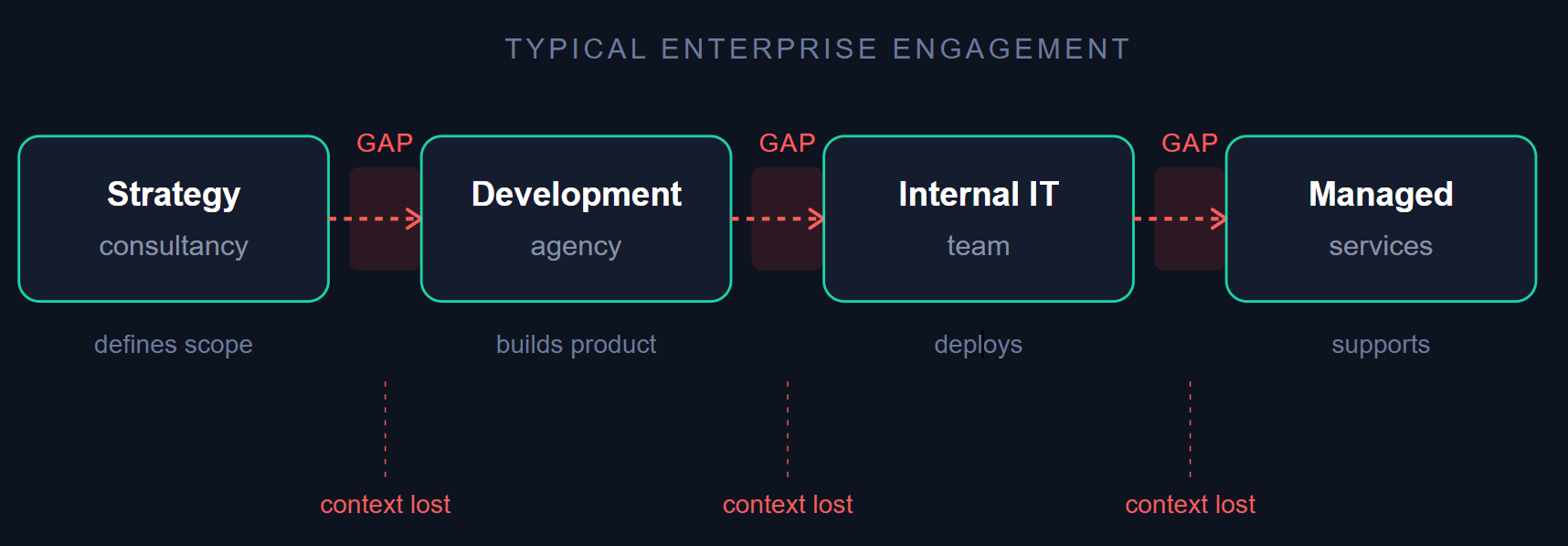
And with every handoff, context gets lost. The knowledge of why the system was built the way it was lives in people’s heads. When those people leave the project, it leaves with them too.
For enterprises operating in finance and healthcare, the consequences are real. And also expensive because in these environments, rough edges can’t be smoothed out post-launch.
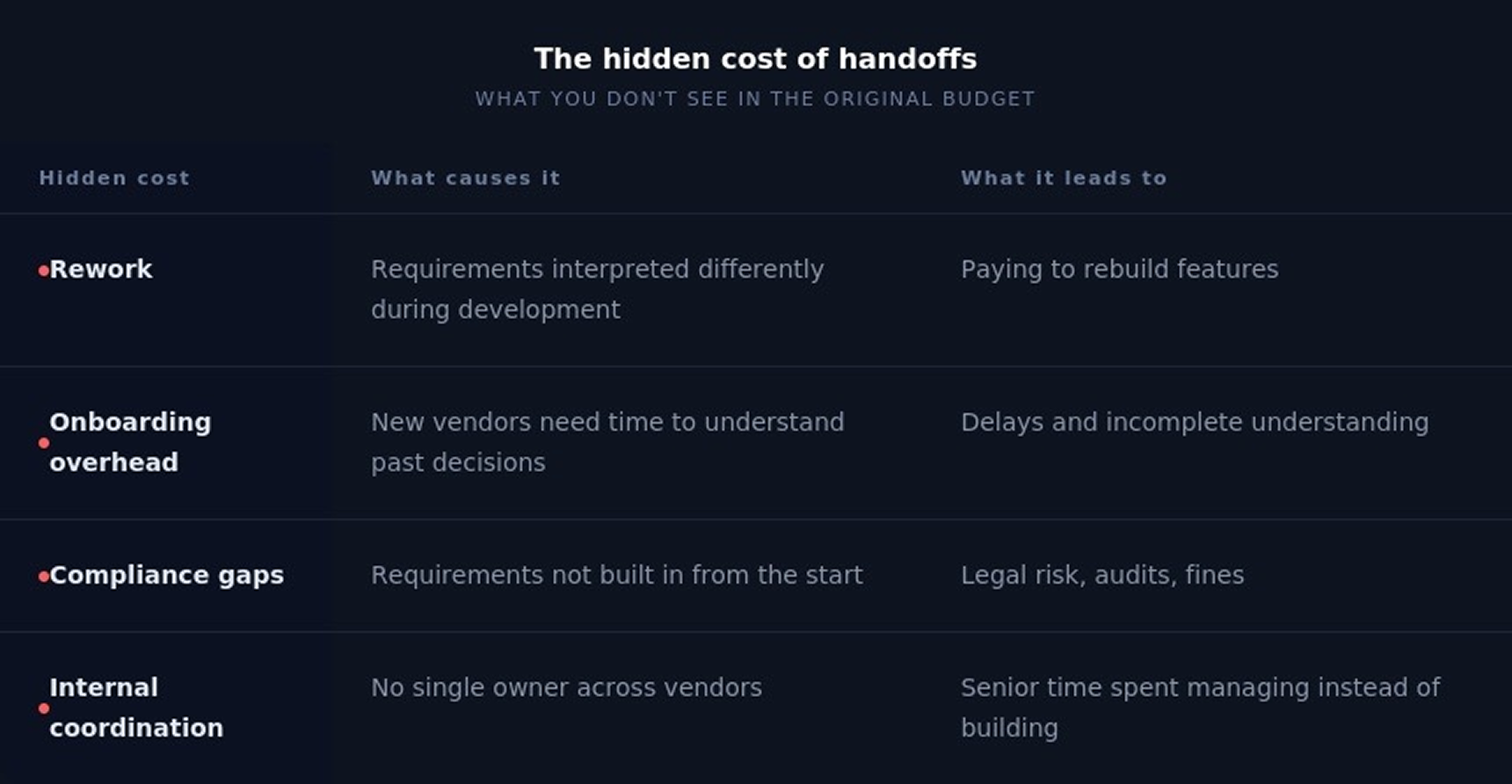
Handoff costs don’t appear in the original budget. By the time they pop up, you are already paying for decisions made long ago by a team that has since moved on. Here are the most common forms they take.
Requirements may look clear in a document, but parts of them are often open to interpretation during development. The development team makes assumptions. Some of those assumptions are wrong. And you have to pay to make it right.
Every time a new party joins a project, they need to be brought up to speed. That slows the timeline and takes attention away from delivery. And even after onboarding, they still may not have the full picture because the reasoning behind earlier decisions wasn’t documented.
For DACH enterprises, this is often the most expensive risk. If a compliance requirement is missed early, fixing it later becomes a legal and operational problem. And enforcement is not theoretical: €1.2 billion in GDPR fines were issued across Europe in 2024.
When no single vendor owns the full system, the gap between them is managed by someone inside the organization. Usually, it’s a senior technical leader who spends their time coordinating vendors, chasing accountability, and translating between parties who do not share context. The more vendors involved, the more of your best people are absorbed into coordination rather than execution.
To prevent this, you need a partner who is still in the room at week twenty and at month eighteen.
A lot of vendors claim to provide “full-cycle development services”, meaning in reality they can help with more than one phase. For us, it means one team owns the project end-to-end. That plays out across all phases, all run by the same team, with no gaps between them. Here’s how it works in practice.
Our product owners run structured alignment workshops with the people who will use the system. The goal here is to build a shared understanding that the entire team carries forward. The Rietmann & Partner engagement began this way. Before any technical decisions were made, we built deep audit domain knowledge.
Our UI/UX designers and engineers share the same context from day one. When the people designing interfaces are working alongside the people building them, design decisions are technically grounded from the start.
With us, testing runs alongside the development. That means issues are caught early, when they are faster and cheaper to fix. It is one of the reasons our clients see 80% fewer bugs.
The team that specified the architecture is the team that deploys it. Infrastructure choices, cloud configuration, security hardening, and data residency requirements are handled by the same people who made those decisions during discovery. Nothing gets lost in translation because no translation is needed.
The partner who built the system supports it, evolves it, and takes accountability when something breaks or needs to change. This is where Modeso's 7+ year average client relationship comes from. Clients stay because a partner with full context and sustained accountability is hard to replace.
For quick comparison, here’s how our approach differs from fragmented delivery:
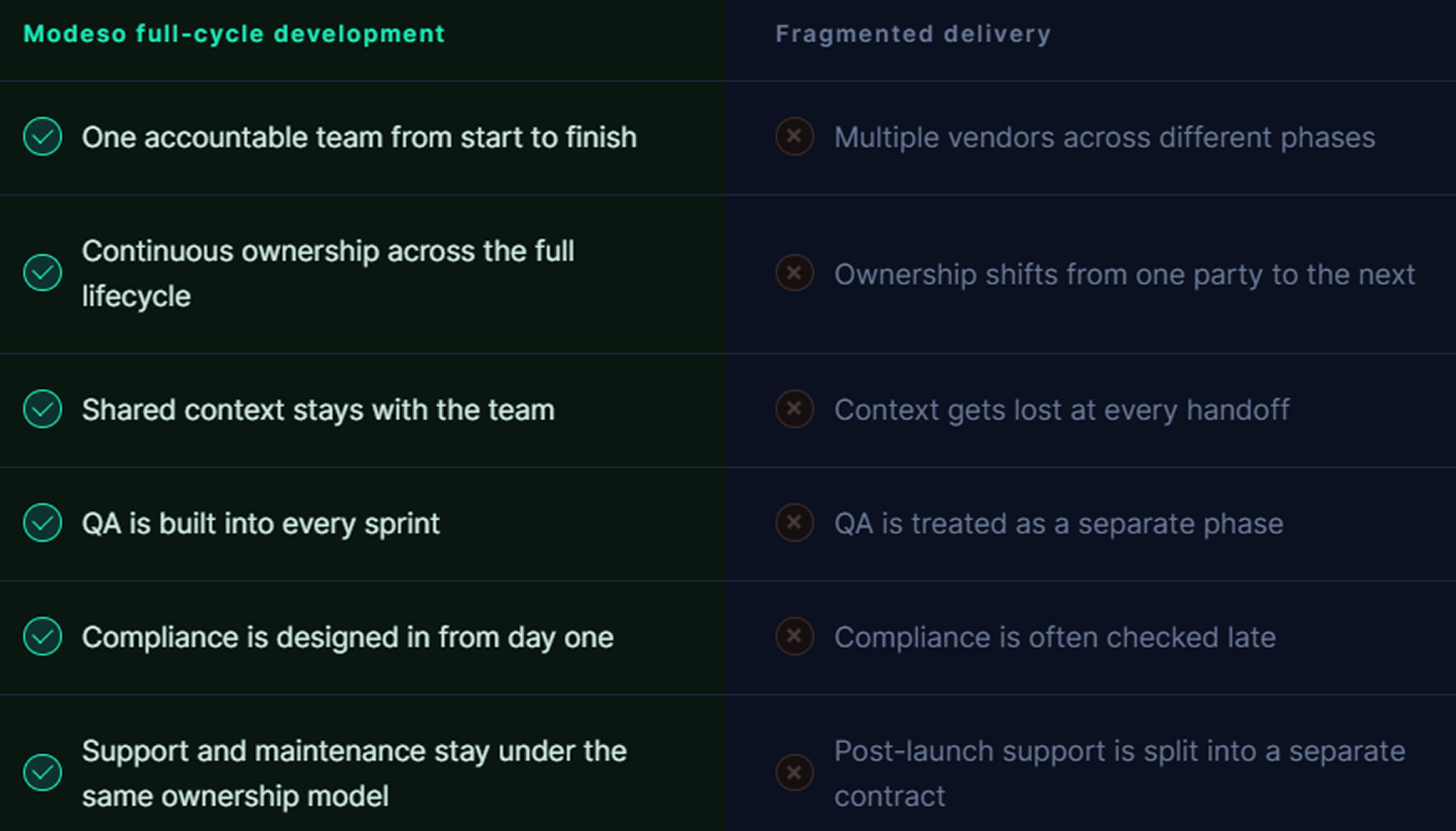
In general, a full cycle is what suits any project and industry. But in DACH markets, the stakes are higher. Here’s why.
In Switzerland and Germany, requirements like GDPR, PCI-DSS, PSD2, and AML/KYC should be locked in at the architecture stage. It means deciding early what data is stored where, how it moves, and so on. A support vendor who joins after go-live cannot retrofit what was never built in. When several vendors are involved, compliance becomes a shared responsibility across parties who each see only their piece. That is the same as saying nobody owns it.
Many DACH enterprises need customer data to stay within DACH borders. It shapes cloud setup, API design, backup strategy, and infrastructure choices from the start. When one partner owns the full lifecycle, data residency becomes part of the design by default.
Swiss and German enterprise teams usually want partners who understand how business is done locally and can sit down in person when a project reaches an important decision. Remote-only models look efficient, but over time, they might lead to misunderstandings.
That’s why Modeso’s product owners and leadership are based in Zurich. Our partners work with people who understand the local business culture, speak German, and can be there in person when needed. At the same time, our development teams are in Egypt, so you are not choosing between local accountability and cost-effective delivery. You get both.
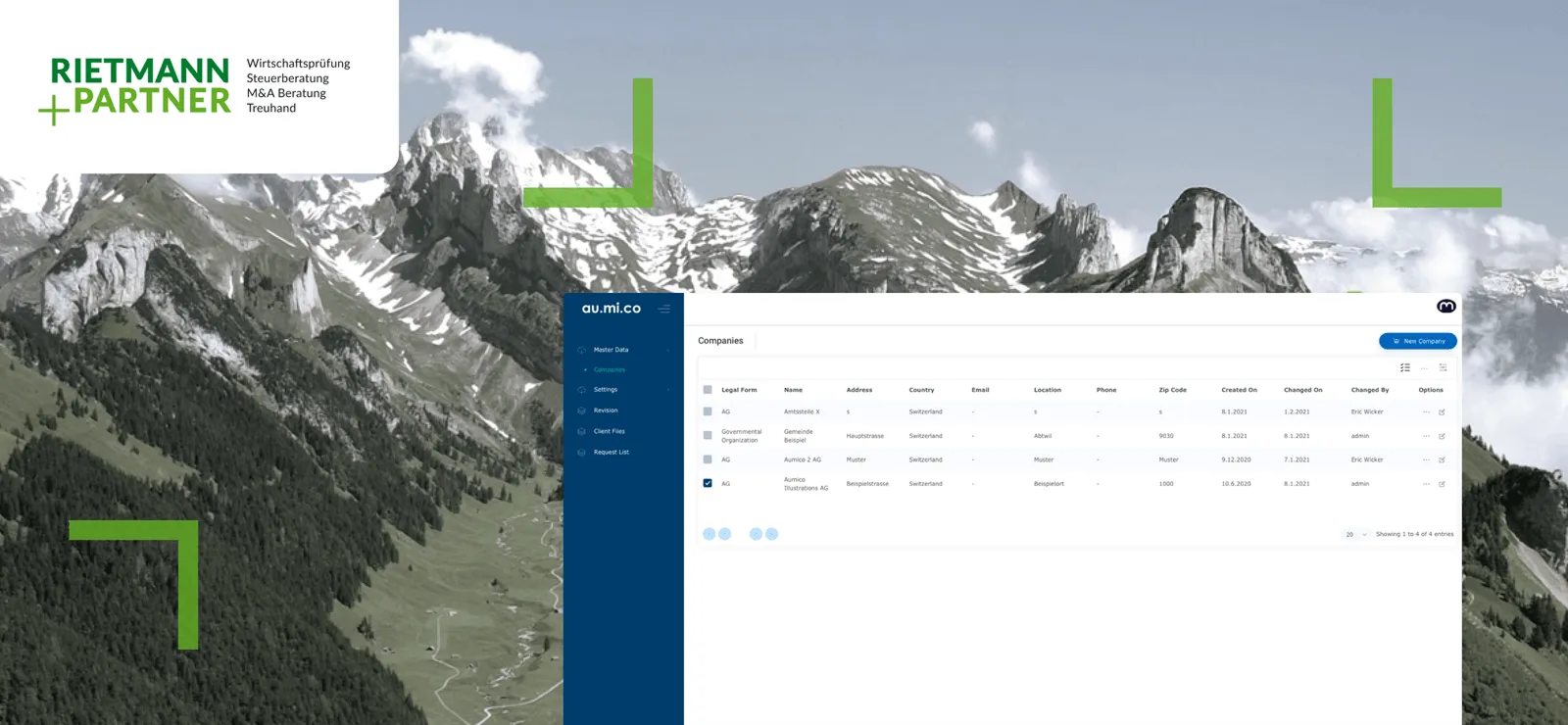
Rietmann & Partner is a Swiss auditing firm with over a century of history. Like many enterprises in regulated industries, they had a process problem that off-the-shelf software couldn't solve. Their audit workflow was manual, complex, and exposed the firm to compliance risk. Every tool they evaluated fell short. So they decided to build a custom solution.
Modeso started with alignment workshops, where we learnt the workflow. That knowledge stayed with the team: the same nine engineers, project manager, QA expert, and designer who carried it through every subsequent phase.
The result was a rule-based auditing system with configurable workflows, multi-tenant architecture, and role-based access controls, built to adapt to auditing standards across Switzerland, Germany, and the USA.
Michael Schwander, Partner at Dr. Rietmann & Partner AG, put it as follows:
That outcome came from one team owning one project, start to finish.
When you evaluate vendors, do not stop at the promise of "full-cycle development." Here is what to pay attention to in how they operate.
✓ You are working with a product owner, not just a project manager
Questions to ask:
🚩 Red flag: The engagement lead cannot answer technical questions directly and escalates everything to someone you’ve never met.
✓ The same team stays with the project across all phases
Questions to ask:
🚩 Red flag: The vendor describes a "handover" between their discovery team and their build team.
✓ QA is part of the process
Questions to ask:
🚩 Red flag: The vendor lists QA as a project phase rather than describing it as part of how they build.
✓ Post-launch support is under the same contract and the same team
Questions to ask:
🚩 Red flag: Post-launch support is quoted separately, with a different team and different terms.
✓ Data residency is a design principle
🚩 Red flag: The answer is vague, deferred to later, or framed as a hosting choice rather than an architectural one.
At some point in every enterprise software project, someone asks who is responsible for a decision made six months ago. In a fragmented engagement, that question has no clear answer. With full-cycle development, that question becomes irrelevant. You have one partner and one accountability chain from requirements to release and everything that follows.
When ownership isn’t transferred, relationships do not end at go-live. Modeso's average client relationship runs over seven years. The team that built the system is still there when it needs to grow and adapt. Most vendors measure success at launch. We measure it at year seven when the system is still running and still supported by the people who developed it.

Datenschutz ist uns wichtig, daher haben Sie die Möglichkeit, bestimmte Speicherarten zu deaktivieren, die für das grundlegende Funktionieren der Website möglicherweise nicht erforderlich sind. Das Blockieren von Kategorien kann sich auf Ihre Erfahrung auf der Website auswirken. Mehr Informationen


