
The financial services industry is both data and regulation-dense heaven, so one human error can cause a disaster. Unsurprisingly, this industry is a great place to implement AI-powered solutions.
AI spending across banking, insurance, capital markets, and payments is on track to nearly triple by 2027, from $35 billion in 2023 to $97 billion. In Switzerland alone, 52% of companies are already automating with AI. And that's only what's officially tracked. Much of it is happening quietly, through tools that never passed a compliance review. The question of whether this technology is coming to financial services has been answered. It's here.
The harder question is which parts of your operation are ready for AI integration, because the wrong starting point might introduce more risk than it removes. Over the past 13 years, Modeso team have built software for TWINT, Albin Kistler, Aumico, and other financial firms in the DACH region. So, fintech is not a new territory for us and we’re ready to share our insights with you.
Below, we explain the most popular gen AI use cases to help you start with what brings the most value for your business.
Plenty of AI tools work in finance, and yes, you can implement one without too much trouble. But a standalone tool won’t bring you much value. You need an AI agent that runs inside your workflow, connects to your existing systems and delivers a result you can measure. The five examples below are all built on that principle.
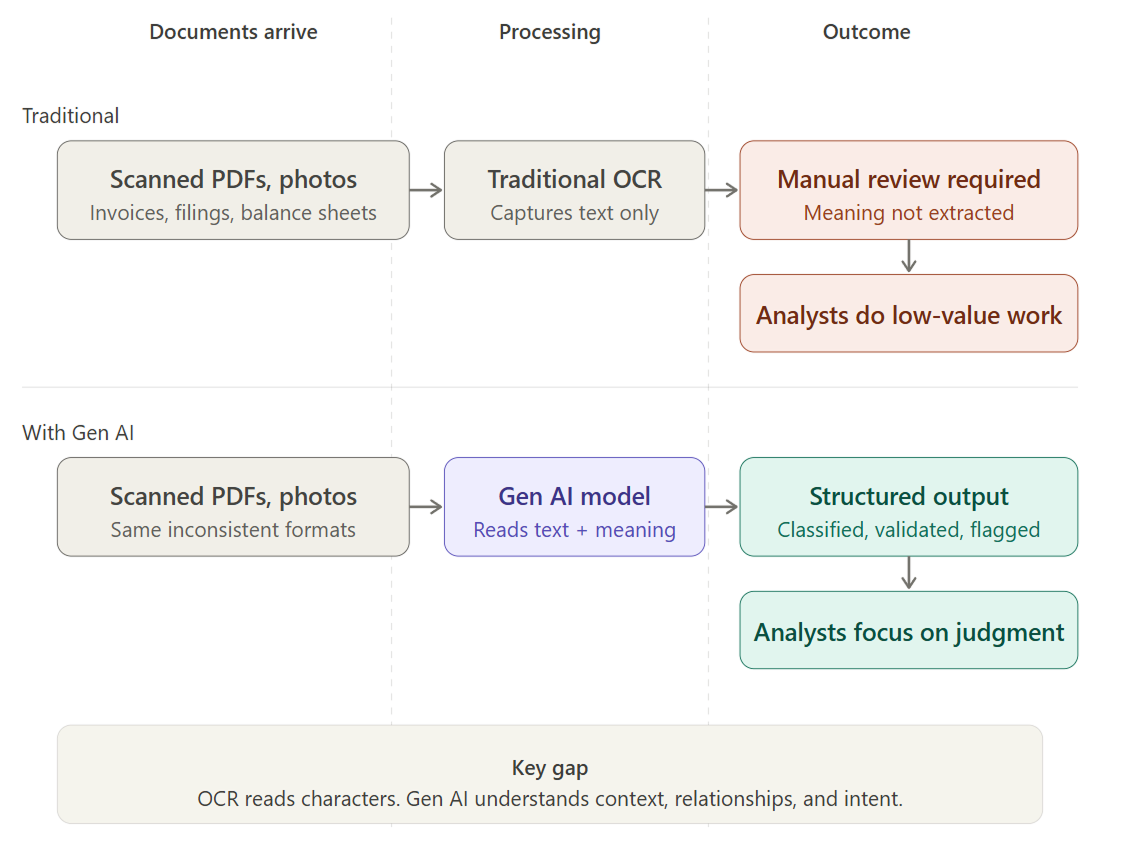
Every tax and audit firm runs on financial statements, invoices, balance sheets, and regulatory filings. Much of it still arrives as scanned PDFs or receipt photos in inconsistent formats. Traditional OCR captures the text, but not the meaning, so the manual check remains. As a result, analysts spend their time on work that does not require their expertise.
A document processing agent is designed to read any document format, extract structured data, run plausibility checks, and route flagged items to a human reviewer. It integrates with DATEV, Abacus, and existing ERP systems. Because it understands documents semantically, it can handle unfamiliar formats better than traditional OCR.
From our standpoint, such AI agents work great for tax and audit firms managing high volumes of financial documents. Our client Rietmann & Partner, a Swiss nationwide auditor established in 1911, faced a structural problem in their audit process. Auditors had to manually navigate required steps across complex workflows with no standardized guide.
Modeso helped them build a rule-based audit workflow system that ingests balance sheets, automatically flags anomalies and irregular financial distributions, and produces regulatory-ready reports. It’s not what we call an AI agent, but we are moving in the right direction.
This AI agent is useful in asset management and portfolio analytics. An analyst’s job is judgment, yet much of the work behind it is still reading. A financial research agent shifts that balance. Connected to internal research libraries and external data sources via RAG, it lets analysts ask questions in natural language and get sourced answers.
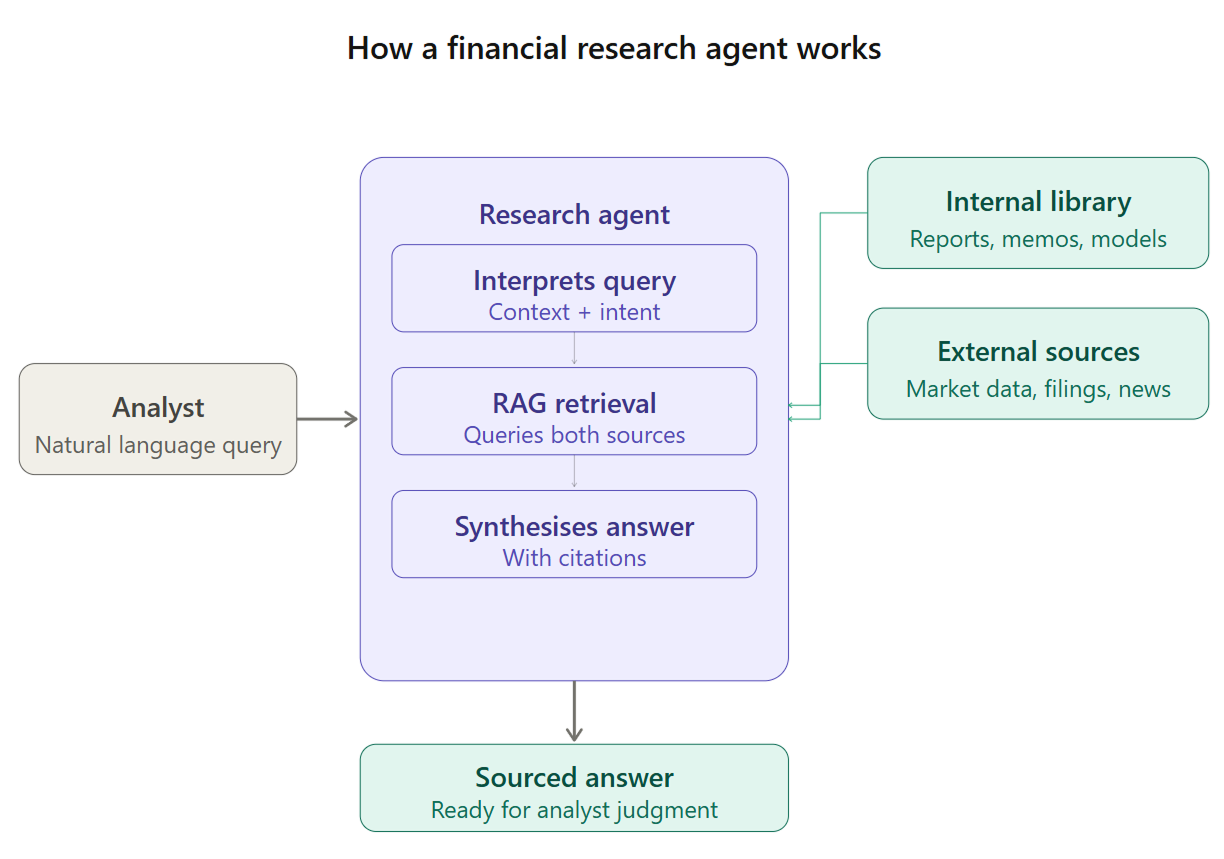
Here’s an industry example. Morgan Stanley's AskResearchGPT, launched in 2024, lets analysts surface, synthesize, and summarize insights from over 70,000 proprietary research reports annually.
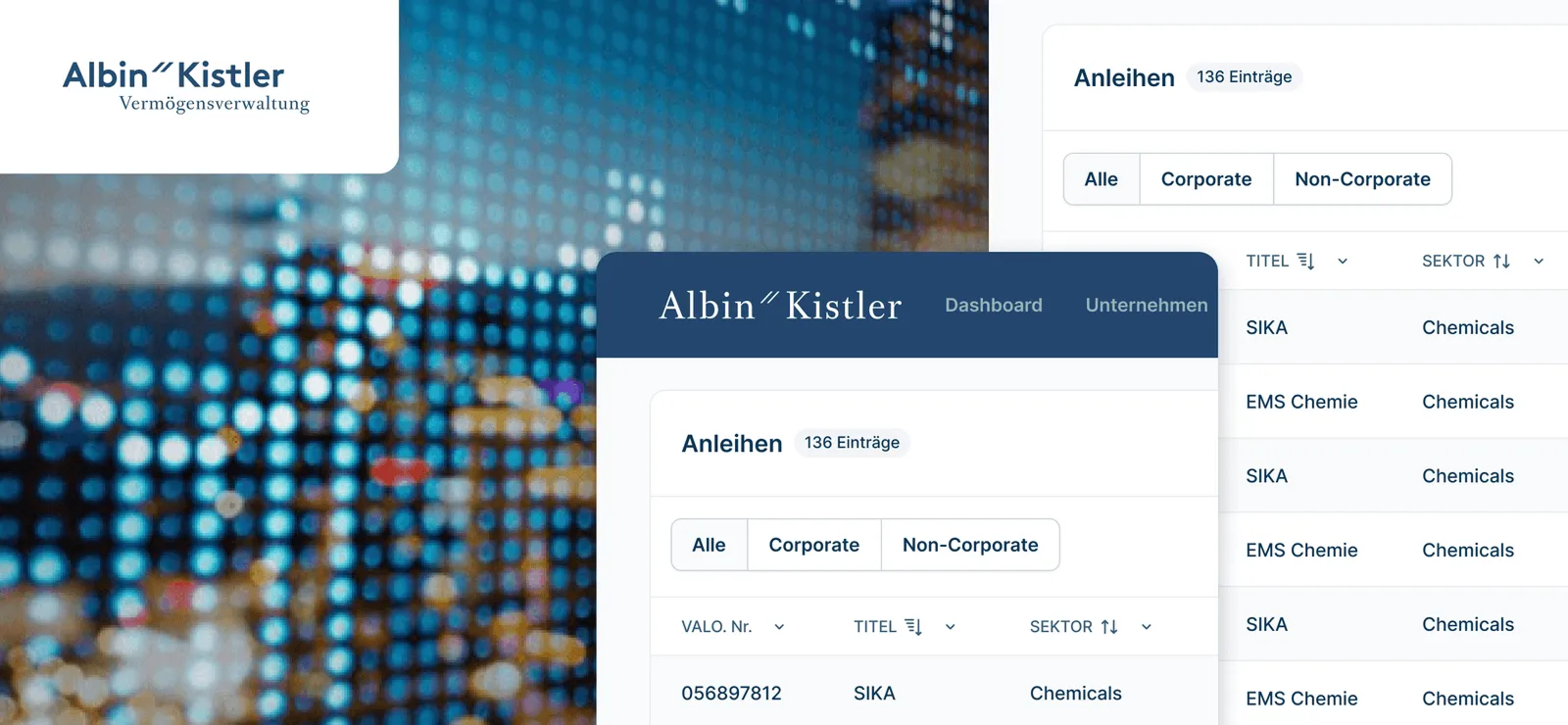
Our company’s examples include Albin Kistler, a leading Swiss asset management company with a proprietary analysis method at the core of its business. But that method ran on a database built 15 years ago in Microsoft Access. We rebuilt it into a modern, extensible platform integrated with SIX apiD and Expersoft's PM1 without touching their proprietary algorithm. From that experience, we know where generative AI can make a difference in asset management.
In DACH financial service companies, a compliance officer's day is almost procedural. Mandated reviews, task lists, documented decisions, and regulator-ready outputs. Valuable? Yes, but most of the processes shouldn't require human intervention.
A compliance and audit workflow agent is a rule-driven system that guides teams through mandated workflows. It flags anomalies, generates the next required step, enforces review sequences, and produces audit-ready outputs. Every decision is logged, traceable, and explainable for regulatory review.
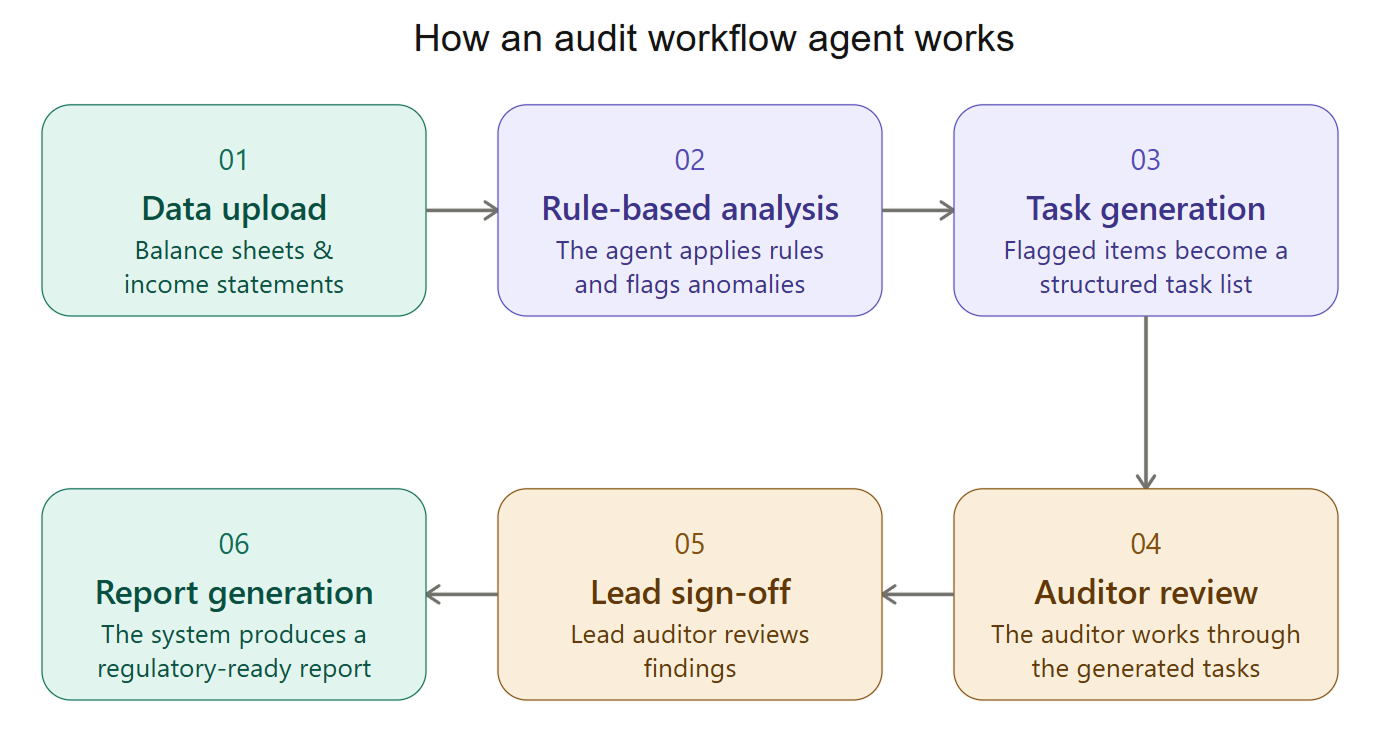
This agent type is well-suited for tax and audit firms and larger financial institutions with substantial compliance overhead. Rietmann & Partner's audit solution is a live example of this pattern: a rule-driven system that applies predefined rules to flag issues and generates auditor tasks.
Finance leaders might refuse to admit it, but their employees are already using AI. ChatGPT or Claude are top choices for summarizing regulatory documents, drafting client emails, and answering internal policy questions. Right now, on US servers, with no EU data governance in sight. In a regulated DACH environment, that's a compliance problem with a friendly interface.
A corporate LLM agent replaces that shadow AI use with a compliant alternative. Such agents can be connected with the firm's internal knowledge via RAG and are fully GDPR compliant. When an employee asks a question, it searches in-house documentation and delivers a policy-grounded answer with a source reference. No data leaves the Swiss infrastructure.
This agent fits in payments and insurance, where customer-facing teams and compliance officers spend their day answering the same policy and regulatory questions, but with different data each time. We know this environment well.
TWINT, Switzerland's leading payment platform with 6 million active users, and Visana, a Swiss health insurer, are both Modeso partners. For these, a corporate LLM agent is a must for improving response times and making every answer traceable.

And here are examples where gen AI already works. Goldman Sachs' GS AI Assistant serves 46,500 employees for document drafting and internal research. Deutsche Bank's DB Lumina connects analysts to internal knowledge sources via RAG, with inline citations, audit logging, and role-based access controls.
Asset managers and banks review hundreds of contracts under time pressure. In practice, highly qualified professionals spend weeks on repetitive work: they read, extract, flag, and route.
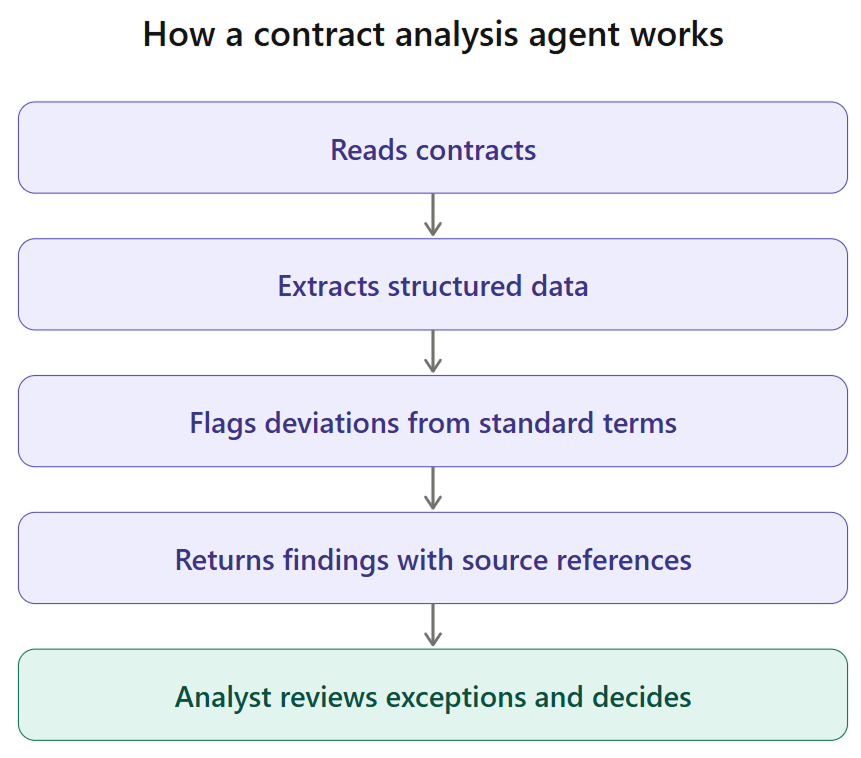
A contract analysis AI agent handles the first three steps. It reads contracts at scale, extracts structured data, flags deviations from standard terms, and returns findings with exact source references. The lawyer or analyst then reviews the exceptions and decides. Of course, documents don’t leave controlled Swiss infrastructure.
Based on Modeso's own benchmarks, structured AI extraction cuts review time by 80% on average. For asset management firms, where contracts form a substantial administrative layer around the investment process, it's weeks of expert capacity returned to work that requires expertise.
The use cases above already work and bring ROI. But most firms aren't running them yet. And the reason isn't the technology. Let's be more specific about what goes wrong.
If your last AI initiative stalled or quietly got shelved, one of these three reasons is almost certainly why.
→ Starting with the wrong use case
When you decide to dive into AI, the right starting point is automating a manual process that is already understood, structured, and measurable. Document processing is a good example: you know what goes in, what should come out, and how to measure the difference.
Many firms, however, do the opposite. They start with the high-visibility use case and discover mid-build that the data is fragmented and the workflow is a mess. That’s why the first step is to define which process is ready for AI and only then automate it.
→ Underestimating integration complexity
Financial companies often scope an AI project without mapping the integration landscape first. They treat API connections to existing ERP systems, compliance platforms, and data sources as implementation details to be resolved later. They never are. The AI model is often the smallest technical challenge involved. As a result, the AI is ready by week six, while the core banking component might not be ready until month five.
→ Treating gen AI as a standalone tool
When one vendor designs the process, another builds the scripts, and internal teams maintain the integrations, end-to-end ownership disappears. Performance degrades, and no one knows the cause. That’s why gen AI implementation requires full-cycle software development where the same team owns workflow design, system architecture, development, integrations, and long-term operation.
Modeso operates this way by design. People who map your process build the agent, handle the integrations, deploy on Swiss infrastructure, and stay accountable for the results after go-live. In practice, that means Swiss-based product owners define the architecture and compliance requirements from day one. The engineering team carries out the build without handoffs, and when something needs fixing six months after launch, the call goes to the people who built it. For a closer look at how each phase of that delivery model eliminates a specific category of risk, read the full breakdown here.
With the right partner, the above mistakes don’t happen. Discover how we build AI agents for fintech in under three months.
An agent built by a team with deep domain experience is integrated into the systems you already run and calibrated to the compliance requirements of your industry. But that is the promise every tech partner makes.
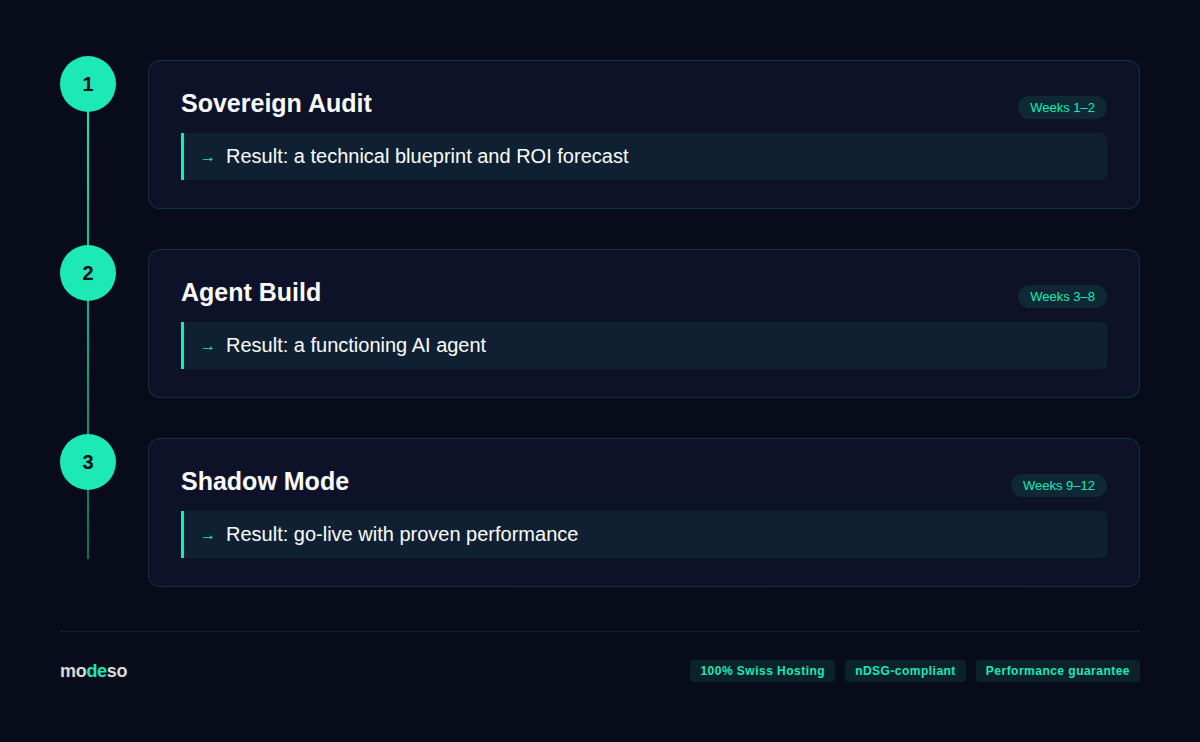
Most vendors ask you to trust the technology. We ask you to define the KPIs first and put money behind the answer. Here's how a Modeso AI engagement works:
Stage 1. Sovereign audit (weeks 1–2)
First, we map the process. We define KPIs, run the nDSG compliance check, and validate the data.
What you get → a technical blueprint and ROI forecast
Stage 2. Agent build (weeks 3–8)
We build a custom AI agent, integrate it into existing systems, and deploy it on Swiss hosting.
What you get → a functioning AI agent
Stage 3. Shadow mode (weeks 9–12)
The AI runs in parallel with your employees on real data, but without real impact. Only when the AI outperforms the manual process does it go live.
What you get → zero operational risk
As a result, you get an AI agent that brings measurable ROI. On average, our systems deliver 10× faster document matching, 5× fewer errors in document processing, and save 15 hours per week. The fixed price for the entire 12-week engagement is CHF 15,000. If you are not satisfied with the result, we have a money-back guarantee. It works like this.
If the AI hits the KPIs we defined together, the full CHF 15,000 is credited toward your ongoing retainer. If it doesn't, you get CHF 10,000 back, and the technical blueprint is yours to keep. Either way, the risk sits with us.
The performance guarantee covers results. But in financial services, you also care about compliance. So, it’s natural that the first objection every DACH finance leader brings into an AI conversation is like “our regulatory environment makes this harder”. With Modeso, it’s not.
All data stays within DACH borders and is deployed on certified Swiss data centers. Our agents are compliant with the Federal Data Protection Act (nDSG) and the General Data Protection Regulation (GDPR) from the first design decision.
You've likely heard similar AI claims from a dozen vendors. Everyone promises results and compliance. Here's what separates Modeso from the rest of the market and why it matters in the DACH region.
Our product owners are based in Zurich. They speak German, understand DACH business culture, and can meet face-to-face. This eliminates the cultural and communication gaps that sink offshore AI projects.
Modeso is not a company building AI for the first time. Our long-term partnerships in financial-grade environments prove we are a reliable player.
We deliver 30% faster time-to-market with Swiss quality standards. Our lean development methodology combines agile delivery with fixed milestones, so you always know where the project stands.
You might assume that starting an AI initiative means big budgets and long timelines. But shadow AI already exists in most companies, so you aren't introducing something completely new. You take what's already happening and give it structure, security, and business value.
The first step is a 60-minute workshop. From there, you can build a working AI prototype and walk away with a clear roadmap for what is possible in your environment within 12 weeks.

Privacy is important to us, so you have the option of disabling certain types of storage that may not be necessary for the basic functioning of the website. Blocking categories may impact your experience on the website. More information


