
Many software development companies have a fintech page. But a banking case study from four years ago and a paragraph about GDPR are not the same as fintech expertise.
Building regulated financial software, where a bug is a big compliance incident rather than a small inconvenience, requires a partner with first-hand experience and understanding of the current fintech landscape.
We’ve gathered a list of fintech software development companies that meet that bar, including our team as well. We've spent 13+ years delivering fintech software in the DACH market, so we know what separates a credible partner from a firm with a well-written fintech offering but little to no experience. For each company, we’ll look at what they’ve built for fintech and how central compliance is to their expertise.
Fintech software development is very complex compared to other types, especially in the DACH region. Once finance enters the picture, the speed and flexibility of a typical software project quickly disappear. Financial software deals with strict regulations and sensitive data, so what gets built has to be protected at every layer.
That's why, when putting this list together, we assessed each company against four key criteria. These are the things worth clarifying before choosing a fintech vendor.
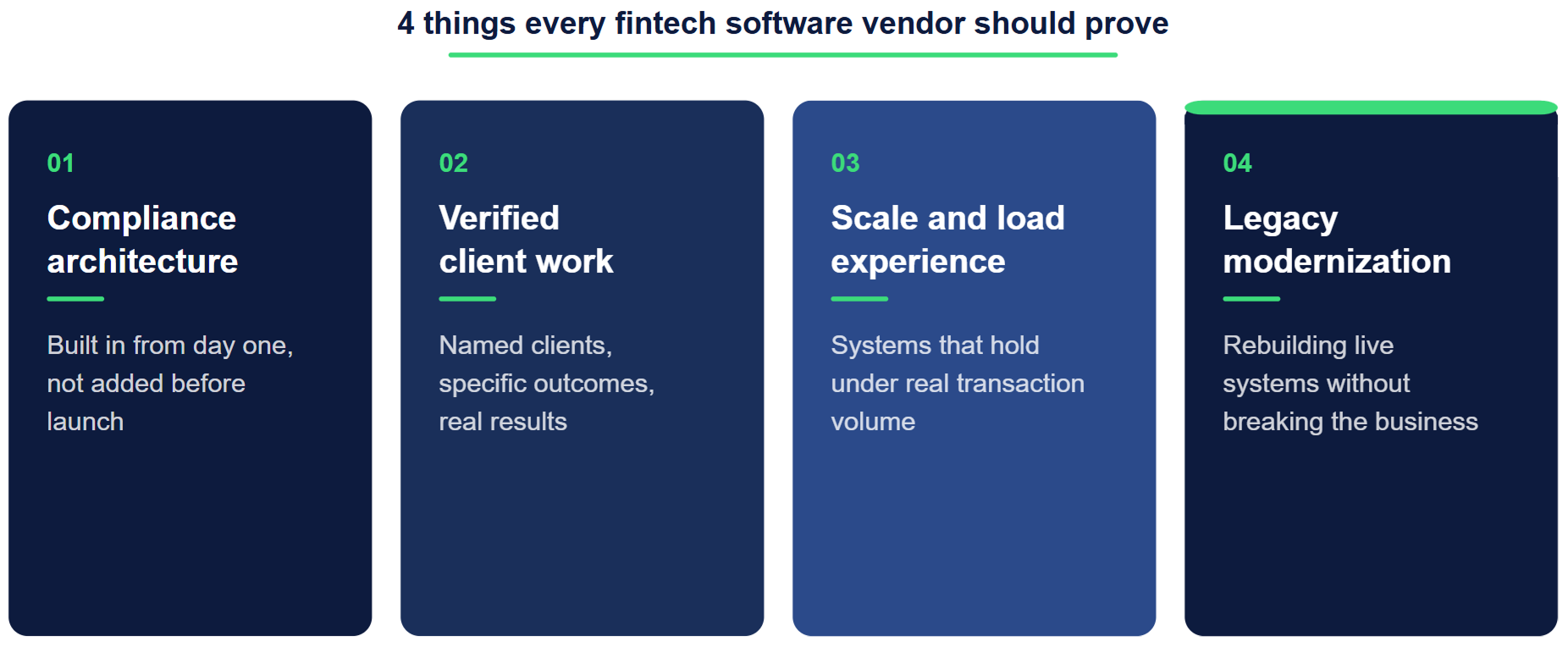
For fintech software, compliance has to be part of the system from day one. GDPR, FINMA, nFADP, PSD2, AML/KYC determine how data flows through the system, where it's stored, who can access it, and how every action gets audited. When those constraints are treated as architectural requirements from the start, they shape the entire system architecture. If not, the product often needs major rework before it can legally operate. We evaluated each company based on this distinction.
Software development vendors tend to highlight their most impressive cases, like well-known brands with large funding rounds, and repeat them across their messaging. What we focused on is proven fintech work, which included specific outcomes and references willing to speak about what the engagement looked like.
Statements such as “we built fintech projects” don’t tell you what was delivered, under what constraints, or whether it worked. That’s why this list focuses on fintech software development companies with verifiable delivery experience in the sector.
Payment apps, insurance platforms, and investment systems all have moments where load spikes. It might be campaign bursts, market events, or month-end processing. A partner who has only built at a prototype scale has never had to solve the architecture problems that pop up at production scale. We looked for vendors with evidence of systems running under real financial-grade load.
Most fintech teams are not building from scratch. They rely on systems that have been running for years, sometimes decades, often built by teams who are no longer there.
Before making changes, a fintech partner first needs to understand how the existing system works. Get that wrong, and core business operations can break. So we also evaluated each company based on its experience in modernizing live financial systems.
Before we get into the companies, a quick note: not every option on this list will be the right fit for you. And some won’t be a fit at all. The best partner depends on what you’re building/replacing and how complex the regulatory side of your product is.
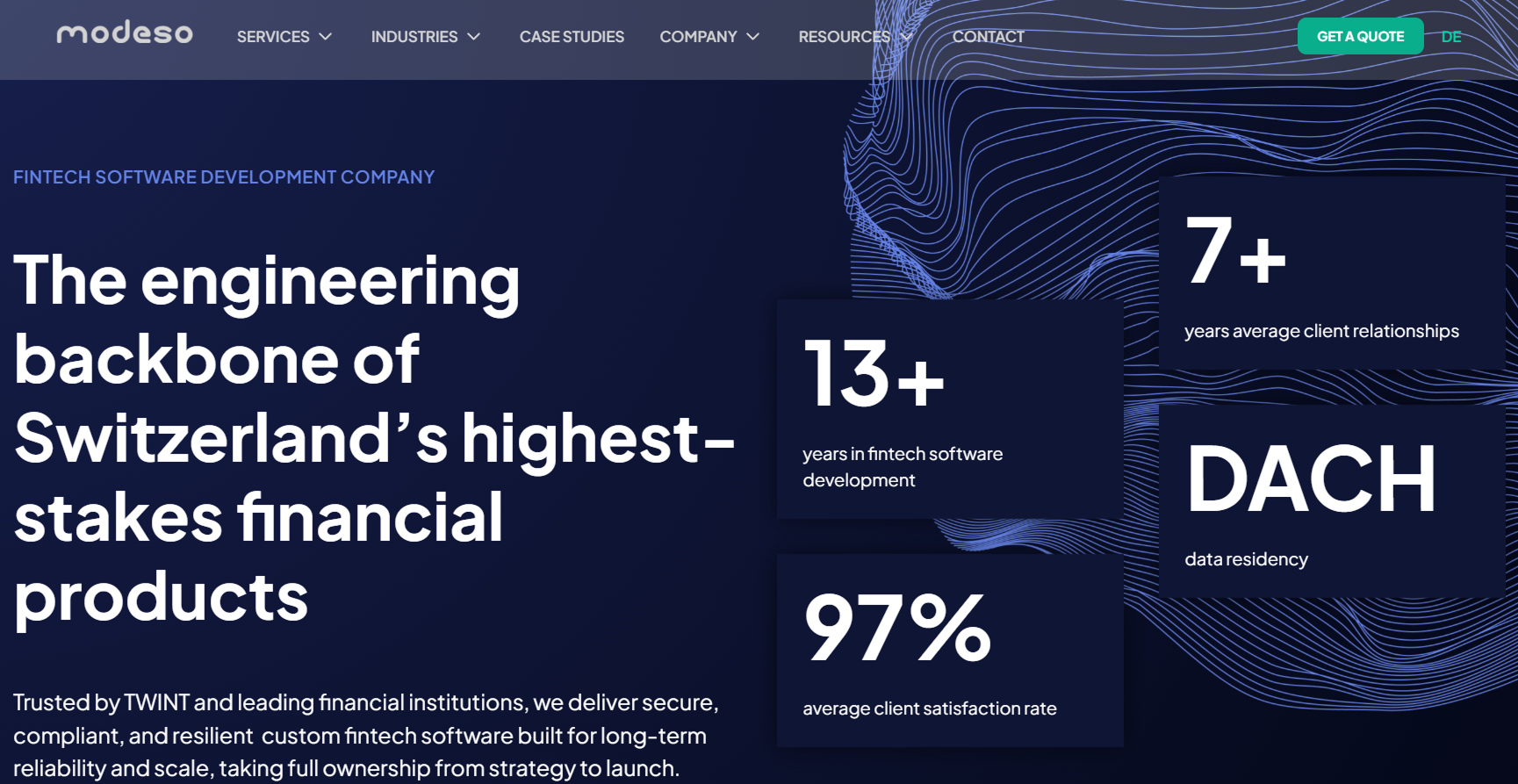
Modeso is a full-cycle software development company serving the DACH financial market. Our Zurich-based product owners manage the client relationship, own the delivery timeline, and carry accountability for the outcome. Senior engineering teams in Egypt handle the technical part. It gives our clients a single accountable contact in their time zone and regulatory environment, backed by engineering depth that a pure-Swiss team at the same cost couldn't provide. Clients stay with us for an average of 7+ years, and 97% of them are satisfied.
Compliance architecture
At Modeso, regulations like GDPR, PCI-DSS, PSD2, and AML/KYC inform architecture decisions from day one. We build around them, making compliance an integral part of how the system operates.
Because our product owners are based in Zurich, compliance decisions are made by people who work within the Swiss regulatory environment every day. At the same time, all sensitive data remains within DACH borders, in line with regional regulatory expectations.
Verified client work
Modeso has built software for many financial companies, including TWINT, Albin Kistler, Visana, Würth Financial Services, Aumico, Rietmann & Partner, and more. Here are details on a few of them.
TWINT
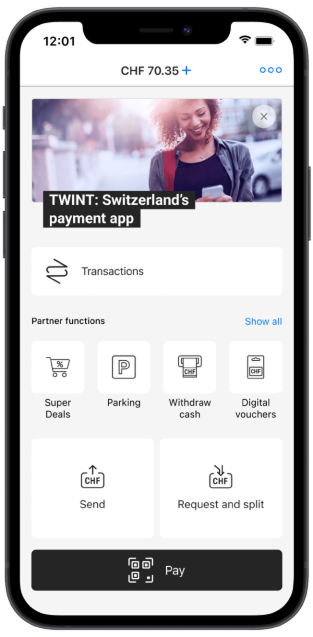
By 2020, TWINT had already become Switzerland's go-to payment app. Millions of people used it to split bills, pay in stores, and send money. The next step was turning it into a marketplace with vouchers, partner deals, insurance products, and gamified campaigns. To make that expansion possible, TWINT partnered with us.
Modeso built each feature as a completely isolated unit separated from the core payment layer. So nothing new could cascade into payments. As a result, TWINT processed 773 million transactions in 2024. Today, it’s used by 6M people and accepted at 80%+ stores in Switzerland. Our partnership is still running.
Visana
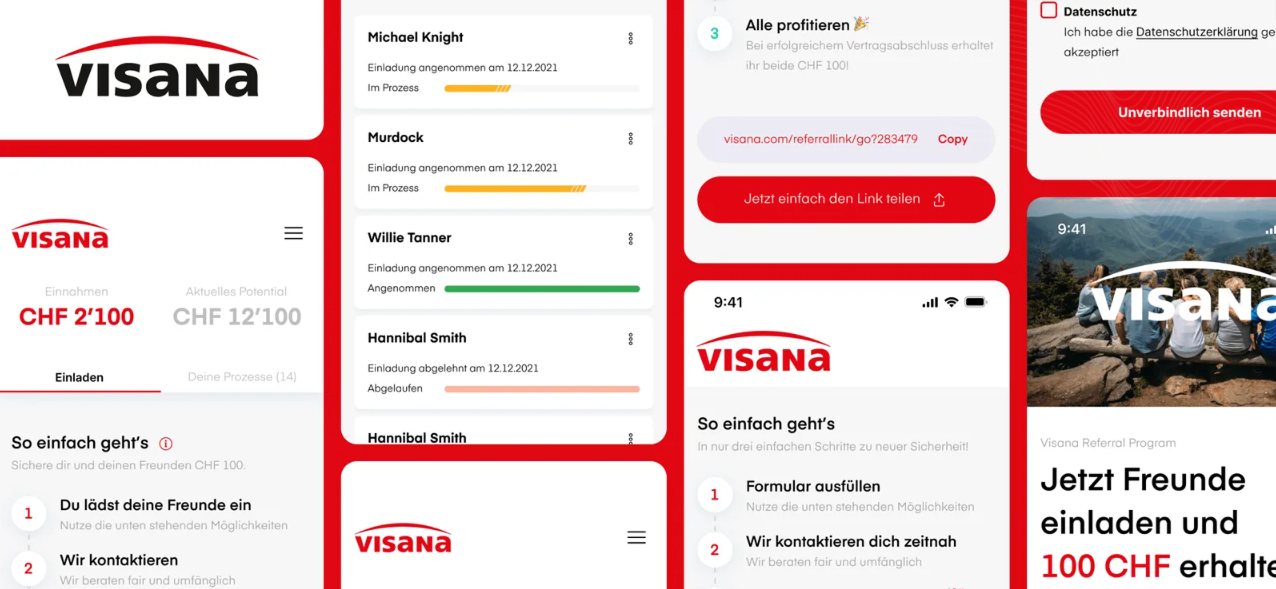
Visana is one of Switzerland’s largest health and accident insurers. Their sales team decided to test a simple idea: could existing customers become a new growth channel through referrals? The challenge was doing it quickly without interfering with systems that handle sensitive insurance data for nearly a million clients.
A direct integration into Visana's back office would have introduced too much risk and slowed the timeline. Instead, Modeso built a referral MVP that lived inside the existing mobile app, connected to back-office systems through a controlled data exchange. The MVP went live in two months, while the core infrastructure remained untouched.
Scale and load experience
We've built systems where the marketplace and payment layers operate independently under extreme load. TWINT is the clearest example. When Spin & Win campaigns ran, 6 million interactions hit the marketplace layer without touching the payment infrastructure beneath it. All because the architecture was designed so that one could never affect the other.
Legacy modernization
Before we touch any legacy system, we map it. Every calculation, every data flow, and every dependency is documented until the logic is fully understood. Only then do we begin the modernization itself. This matters in financial services more than anywhere else, because the system being replaced is usually the one the business depends on today.
The Albin Kistler case shows what that looks like in practice. It’s a Swiss asset management company for private and institutional clients with 6B+ CHF in assets. Their core investment algorithm had been running in Microsoft Access for 15 years and had become difficult to extend. To rebuild it without losing the proprietary logic that sat at the heart of their business, Albin Kistler partnered with us.
First, we worked through the mathematical logic with subject matter experts and rewrote the documentation to create a shared understanding across all stakeholders. Only then did we re-implement the algorithm and overhaul the technology stack for Albin Kistler. The new platform went live in November 2023 on a private Swiss financial cloud, with full data migration from the old system.
Innowise is a software development company with experience in digital banking, payments, lending platforms, and open banking solutions. The firm operates in multiple European offices, which gives it the capacity to run parallel workstreams on complex programs. The trade-off for that scale is the structure. At a company this size, the quality of the engagement depends on the team composition and who leads the project, which is worth establishing before work begins.
Compliance architecture
Innowise builds financial systems that meet PSD2, PCI DSS, GDPR, ISO 27001, SOC 2, and AML/KYC requirements. And their track record proves that. For example, they implemented PSD2 and eIDAS compliance for one open banking project. The system they built provides regulated third-party access to account data and supports payment initiation under EU rules, which means compliance decisions shaped the API design from the very beginning.
Verified client work
Innowise's fintech portfolio spans banking platforms, AI-driven analytics, and payment infrastructure in Europe, the Middle East, and North America.
For instance, they created a banking web app for money transfers and merchant analytics, an e-payment ecosystem for mobile apps, a centralized data management repository for banking, a KYC solution for embedding in mobile applications, and more. That said, many of their financial case studies are anonymized, so the client context behind each project is limited.
Scale and load experience
Judging from the Innowise website, they deliver solutions that scale. They mention a SaaS banking platform built specifically for high-volume payment processing and an investment analytics platform handling large financial data pipelines.
Legacy modernization
Legacy modernization is a named service offering, including mainframe support and system upgrades for financial clients. Specific case outcomes on this criterion are not detailed on the website.
Kindgeek is a fintech-focused development company where over 80% of the portfolio is in financial services. They build consumer-facing regulated fintech products, like digital wallets, neobanking platforms, white-label banking infrastructure, and have people with financial services backgrounds on the team alongside engineering.
Compliance architecture
At Kindgeek, compliance is an automated layer built into the engineering workflow itself. Every pull request runs automated checks against PCI DSS, DORA, and GDPR. KYC/AML edge cases get AI-generated test suites before each release. The company is also ISO 9001 and ISO 27001 certified.
Verified client work
Kindgeek's client list covers consumer finance apps, B2B payment networks, and other fintech solutions. HyperJar, a UK consumer finance app, was built with Kindgeek engineers over a year, taking the product from development to market-ready. payabl. and JAJA are both live, regulated European fintech products. 70% of clients come through referrals, and the average partnership runs over two years.
Scale and load experience
Kindgeek builds fintech software designed to scale. Their stated approach centres on software that can be modified and expanded as transaction volumes grow. For example, their digital wallet infrastructure uses automatic load balancing and dynamic scaling under peak demand.
Legacy modernization
This is not Kindgeek's primary credential. Their track record is in building new regulated fintech products, not rebuilding systems that have been running for years. They are strong for greenfield builds and white-label infrastructure. If you need legacy modernization, other firms on this list have more visible experience.
Scalefocus is a mid-to-large European engineering firm with financial services expertise. Their model involves deep involvement in client architecture decisions. On several engagements, for instance, Scalefocus team members have occupied lead positions in the client's architecture strategy and compliance certification process.
Compliance architecture
Scalefocus doesn't publish a standalone compliance framework, but compliance shows up in projects they delivered. For example, when working on the Middle Eastern neobank project, Scalefocus was involved in obtaining local financial authority certification. They also developed a digital wallet for in-game purchases with KYC integration.
Verified client work
Scalefocus has built fintech products across four continents, from European investment apps to Middle Eastern neobanks to Swiss financial infrastructure. Rubarb, the first European fintech to offer free ETF investments, was built from concept to launch by Scalefocus, including UX, architecture, and regulatory compliance for the EU market. For aXedras, a Swiss precious metals startup, Scalefocus developed a blockchain-based platform connecting mines, refineries, banks, and buyers.
Scale and load experience
Scalefocus states that platforms built by their team process more than 10 billion transactions. Of course, that doesn’t mean one single system handles all of them at once, but it does suggest experience working on high-scale financial projects. If you need more technical details around infrastructure, load handling, or architecture decisions, it’s worth discussing those specifics directly with their team.
Legacy modernization
Scalefocus lists legacy platform modernization as a named service under software engineering, but their legacy modernization track record is not the strongest in fintech.
The Software House (TSH) is a Polish software engineering firm focused on code quality and long-term architecture rather than domain consulting. It’s a strong fit for fintech teams that already know what they want to build and need a reliable technical partner to execute it properly. TSH ships systems that handle financial-grade load, pass investor security reviews, and stay easy to maintain as the product evolves.
Compliance architecture
TSH builds compliance infrastructure as a technical layer. It covers automated KYC with document validation and biometric authentication, real-time risk scoring, transaction monitoring with anomaly detection, and full audit trail and regulatory reporting. On the security side, they prepare products for ISO 27001 certification and SOC 2 compliance, and implement SIEM systems for real-time monitoring and incident response. TSH’s approach treats regulatory requirements as engineering deliverables, not sign-off steps.
Verified client work
When you look at all TSH’s case studies, many of them come from the fintech sector. Their portfolio includes payment systems, lending platforms, and financial data solutions for European clients.
For instance, TSH automated the full loan application process for a UK fintech loan platform, compressing approval time from 60–90 days to a 5-minute target. One more example is a European payments company xpate. TSH built a payment infrastructure where merchant payout times dropped from days to minutes.
Scale and load experience
The Software House builds on microservices, serverless architecture, and AWS. This stack is designed for financial-grade scalability. Individual components can be scaled independently, which matters in fintech, where payment flows cannot go down during peak periods.
Legacy modernization
TSH offers modernization services with refactoring, replatforming, and rebuilding. Yet, their fintech track record is stronger on incremental improvement and cloud migration than on large-scale legacy rebuilds.
DeepInspire is a boutique software development company with a deliberate approach to keeping the client relationships deep. In fact, their longest engagement has lasted 11 years. Most of their work is under NDA, which means the client list is actually longer than what’s presented on their website. DeepInspire delivers solutions for online banking, trading platforms and exchanges, payments and digital wallets, investment management, lending, and BaaS infrastructure.
Compliance architecture
On its fintech page, DeepInspire states that it covers key regulatory requirements for financial products, including KYC, KYB, AML, GDPR, data encryption, and biometric security. Their case studies support those claims. For example, the company built a custom KYB solution for an institutional-grade trading platform.
Verified client work
More than 80% of DeepInspire’s projects come from the fintech sector, although many are not publicly disclosed due to confidentiality agreements. Still, the public work shows a clear pattern: complex fintech products where the company handled full-cycle delivery. Their portfolio includes a financial well-being platform, a commodity trading platform, and a back-office solution for a banking-as-a-service provider.
One of the publicly known clients is Baird & Co, the UK’s largest gold refiner. For them, DeepInspire rebuilt the trading platform with a custom high-performance transaction engine and Barclays banking integration.
Scale and load experience
DeepInspire builds trading platforms, payment systems, and BaaS infrastructure with stability and scalability as stated design requirements. When developing a commodity trading platform, they created infrastructure that made it easy to add new products and functionality over time.
Legacy modernization
If any company can boast legacy modernization experience, it’s this one. The Baird & Co project was a full rebuild of an outdated system. DeepInspire replaced the legacy transaction engine, automated manual sales processes, integrated Barclays for payments, and added a real-time inventory management system. Based on this case, the company shows hands-on experience with legacy modernization at a production scale.
That’s all about the companies we cover here. To better compare them side by side, here’s a quick overview of each vendor.
The case studies tell you what a company has built. These questions will tell you how they work and who is accountable when complications pop up.
On compliance:
On delivery:
On track record:
On risk:
The companies that answer these questions without hesitation are the ones to shortlist. Still, the final choice should depend on whether they’ve worked on projects similar to yours before.
Every company on this list has experience working in regulated financial environments. And that in itself is good. But you need the one that can solve your specific problems in your regulatory environment, at your build stage, with full accountability for what gets shipped.
If you're launching a new fintech product from scratch, such as a digital wallet, a neobank, or a white-label payments platform, Kindgeek and Scalefocus both have strong greenfield track records.
If you already know what you're building and need disciplined technical execution for payments infrastructure, lending automation, or financial data pipelines, The Software House is the strongest fit on this list.
If the project involves a legacy system that can't go down, for example, a core algorithm running in a 15-year-old environment or a back-office platform the business depends on, DeepInspire and Modeso both have visible modernization track records.
If the project is large enough to require parallel workstreams and a big team, Innowise has the capacity.
If your product operates under Swiss or DACH financial regulations, like FINMA, nFADP, GDPR, PCI-DSS, and you need a vendor who treats compliance as an architectural requirement, that's where we've spent the last thirteen years:
If any of this sounds like what you need, you know where to find us.

Privacy is important to us, so you have the option of disabling certain types of storage that may not be necessary for the basic functioning of the website. Blocking categories may impact your experience on the website. More information


