
The typical DACH wealth management platform in 2026 was actually built somewhere between 2005 and 2015. The team that designed it has since turned over two or three times. The business logic still exists and works, but it's buried somewhere inside the system. Nobody is quite sure where.
When firms decide it's time to modernize, they often divide the work into separate projects, with one team focusing on data migration, another on the interface redesign, while a third evaluates AI tools. So when the AI team arrives, it inherits a system they didn't design, built on data they didn't clean.
The AI model will run on whatever it's given. And if the modernization was split across three teams, what it's given won't be reliable.
So before you can make AI work, someone must own the entire modernization journey, from architecture and data to the foundation that makes every future initiative possible. But who should that be, and how does that work in a real transformation project? Let's start with the root cause — ownership, and work forward from there.
When technology leaders discuss digital transformation in wealth management, they often focus on tools. But technology is not the primary obstacle.
In the survey Modeso conducted with approximately 200 tech leaders across Switzerland, Germany, and the UK, the top concerns about working with external development partners were about accountability. They mentioned timeline unpredictability, pricing opacity, and miscommunication across handoffs.
This is familiar territory for wealth management CTOs. The board wants AI, but the platform isn't ready. And every vendor conversation starts with the technology, when it should start with the ownership structure.
This isn’t something revolutionary, though. Full-cycle software development has existed for decades because complex systems require full ownership. The same people who make the foundational decisions understand the consequences of those decisions years later, when new capabilities enter the picture. Without that ownership, you're running a series of IT projects that will need to be redone. We know it from our own experience.
Modeso has spent 13+ years building and modernizing business-critical platforms for DACH financial firms. Every digital transformation project is different, but the principles behind successful engagements remain the same. The Albin Kistler case shows what they look like in practice.
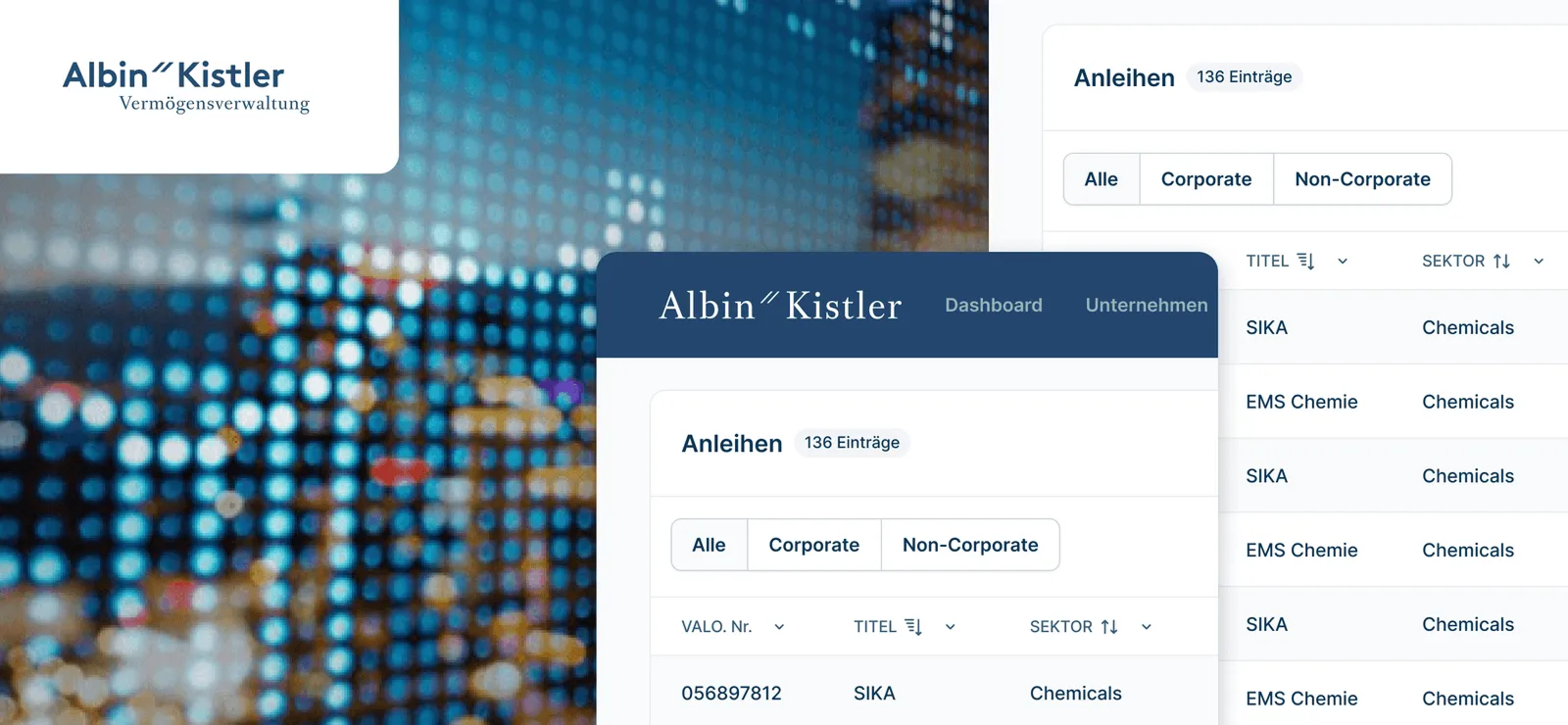
Albin Kistler is a Swiss investment manager whose core platform had been running for 15 years. It was built on Microsoft Access by a small team that had long since left. The core investment algorithm existed in the system but wasn't documented. That's when they brought in Modeso.
First, we reverse-engineered the existing algorithm step by step. Only when every developer could follow the logic from raw data inputs to final output did the rebuild begin. Then came the overhaul itself. We moved the algorithm to a modern web platform, implemented three external integrations (SIX apiD, Expersoft's PM1, and Active Directory), and deployed it on a private Swiss financial cloud.
The Albin Kistler engagement ran from 2022 through 2023. The platform went live in November 2023, following a soft launch and data migration in October. Release cycles, the time from building a new feature to deploying it, dropped by 50%. Live bugs dropped by 90%, because the logic that had been opaque for 15 years was now documented.
What made the difference? The way we owned the work from start to finish.
The Albin Kistler engagement is a good example of the practices that lead to successful outcomes so we’ll use it to explain how we typically operate.
Understand before you build
With legacy platforms, the biggest risk is building on assumptions. So first, the existing system has to be understood. At Albin Kistler, we started with alignment workshops to rewrite the algorithm documentation in Modeso's own words. By the end, every stakeholder had a common understanding of what the platform did and why.
Start with the business core
Before deciding what to rebuild, you should be clear on which capabilities are central to the firm's success, which processes support them, and where the existing platform is limiting growth. Only then can you make technology decisions with confidence. In Albin Kistler’s case, the core was the proprietary investment algorithm. So every decision was organized around protecting that algorithm.
Match the delivery approach to the problem
Different parts of a wealth management platform require different handling: some carry more risk, some more complexity. A compliance engine, for example, has to work completely before anyone can evaluate it (because you can't test half a calculation). A user-facing dashboard is different since users can start interacting with an early version and help shape future iterations.
At Albin Kistler, we used the Waterfall for the core algorithm rebuild. Users needed to see the whole calculation engine working correctly before they could tell us whether it was right. When the foundation was solid, we switched to Agile for everything built on top of it.
Scale the team when needed
No matter how well you plan, some complexities become visible when the work begins. For Albin Kistler, the algorithm turned out to be more complex than expected. To handle it properly, we brought in a dedicated business analyst who worked with the client's experts. The team changed because the problem required it.
Build a proper data foundation
Wealth management platforms run on data. Get that wrong, and every capability you build afterwards is unreliable, however polished the front end may be.
In the case of Albin Kistler, a substantial part of the work was the data layer. We connected SIX apiD, PM1, and Active Directory, and made sure data moved between them. It matters because everything that follows depends on it. Reporting, client servicing, analytics, and eventually AI. All of it inherits whatever the data foundation is.
Treat launch as the beginning
A modernization project ends when the business no longer needs new capabilities. If it's done right, that day never comes.
Our partnership with Albin Kistler didn't stop at go-live. The next phases are already underway and include Microsoft 365 integration, rule-based simulations, and a self-service BI layer that will let analysts build their own dashboards and extract insights directly from the data.
If your platform is aging and AI is on the roadmap, use these principles as a benchmark when choosing who to work with.
Principles of wealth management modernization
Remember the AI team that arrives last, inheriting a system it didn't build? When the same team owns the modernization and the AI, that scenario doesn't happen.
Modeso operates as an external AI department for wealth management firms. We take the project from first analysis to a production-ready AI agent in 12 weeks. The process is structured in three phases.
Weeks 1–2: Discovery & analysis
In the first two weeks, the team analyses the firm's processes, identifies the highest-value AI opportunities, and defines measurable KPIs.
The output → a technical concept and an ROI forecast.
Weeks 3–8: Development & integration
We build the AI agent and connect it to the firm's existing infrastructure, with weekly reviews throughout.
Weeks 9–12: Deployment & optimisation
The team goes live, monitors performance, and fine-tunes until the KPIs are achieved. All of it is Swiss-hosted and compliant with the nDSG and GDPR by default.
And if the agreed KPIs are not met after 12 weeks, you receive CHF 10,000 back in full plus a technical concept (blueprint, valued at CHF 5,000).
For firms that want to go further, the retainer model continues the relationship from month four. You get a dedicated AI team and a fractional Chief AI Officer for strategic direction.
From 0 to AI in 12 weeks
Not sure where to start? Modeso offers a free 60-minute Prompt-to-Prototype Workshop. In one session, you build your first working AI prototype yourself and get an initial assessment of what is achievable in 12 weeks.
You can probably agree that modernization and AI are one journey. And the same team needs to own both.
Think about it. The engineers who made the architecture decisions at the start are the only ones who know what the system can handle. Nobody else does. Bring in someone new at any stage, and that knowledge is gone.
If you want a platform that can take on whatever comes next, like new regulations, new integrations, or AI, you need a partner who was there from the start and plans to stay. Modeso can do that.
Of course, we're not the only full-cycle software development partner you can choose from. If you decide to work with someone else, use these questions to evaluate whether they're the right fit for the job.
If a partner can't answer these clearly, that's already an answer.

Privacy is important to us, so you have the option of disabling certain types of storage that may not be necessary for the basic functioning of the website. Blocking categories may impact your experience on the website. More information


