
Ask a CFO whether their team has automated accounting processes, and the answer is almost always yes.
Now ask the same CFO whether their accounting workflow is consistent and auditable, and the answer changes. Usually, to a pause, followed by a careful no.
This is the central paradox of accounting automation today: you have the tools, but you're still doing it by hand. So why is that?
Because more automated tools won’t save the day. You need to embed automation into your workflows.
Below, we’ll break down why workflow design comes first in accounting and finance automation and what that looks like in practice.
When accounting teams think about automation, they usually start with SaaS. And that makes sense. SaaS tools can import bank feeds, flag anomalies, generate reports, and run reconciliations faster and more accurately than a human could. But they don't know where they sit in your process.
Each tool solves its own isolated problem and leaves the connections to you. The result is a workflow nobody designed, but everyone maintains. In many accounting teams, it looks like this:
ERP → Excel → manual checks → email approvals → reports
The ERP records transactions automatically — that part works. But when it hits something it wasn't configured for, someone has to bridge the gap in a spreadsheet. Then another person checks what the systems couldn't reconcile. Approvals travel by email, outside any system. And at the end of the chain, reports generate themselves, but you don't know what's hiding in the gaps beneath them. And as the business grows, these gaps multiply.
Accounting is a rule-driven process with dependencies built into its structure: certain things happen before others, validation occurs at specific points, and approvals are attached to decisions.
When automation ignores this and treats accounting as a set of isolated tasks, the process becomes a black box with weak quality control, compliance exposure, and inconsistent documentation. Worst of all, the process starts depending on specific people who become impossible to replace.
Side by side, the difference between task automation and workflow automation is hard to miss:
Task automation is not enough because in accounting, automation has to start with the workflow. It helps embed rules and validation logic directly into the system, so no one has to reconstruct it manually afterward. Off-the-shelf tools can't enforce this structure because they weren't built around your process. You need a tailored solution designed for your workflows from day one. But only if you know what you're building around.
Building a custom system is already the right call. But before development starts, you need to understand how your accounting process works and design the workflow behind it. Here’s how we approach it at Modeso:
Document how work flows across teams, systems, and approval chains. This includes the “unwritten rules”, like side checks, spreadsheet trackers, and manual overrides that teams rely on but never document.
What it covers:
When the workflow is clear, the next step is to make its logic explicit. Identify every checkpoint, approval requirement, compliance obligation, and quality gate that determines how the process should run. At this stage, you also define what can be flexible and what must stay fixed in the process.
Instead of relying on rules stored in people’s heads, you:
Next, you need to translate the concept into a technical design. This blueprint should describe how the core functions will work in practice. It creates a shared foundation for development and reduces the risk of building the wrong thing.
What you get:
Develop the system step by step, using continuous feedback to test and refine the workflow. This way, it’s easier to improve the system while decisions are still easy to change.
Each iteration includes:
Implementing a specific workflow segment (for example, invoice intake → validation → approval)
↓
Configuring rules and roles for that segment
↓
Testing it with real data
↓
Collecting feedback from actual users (accountants, managers)
↓
Adjusting logic, UI, or flows based on findings
Improve the system based on real usage, so it fully meets compliance requirements and supports core accounting processes.
What to focus on:
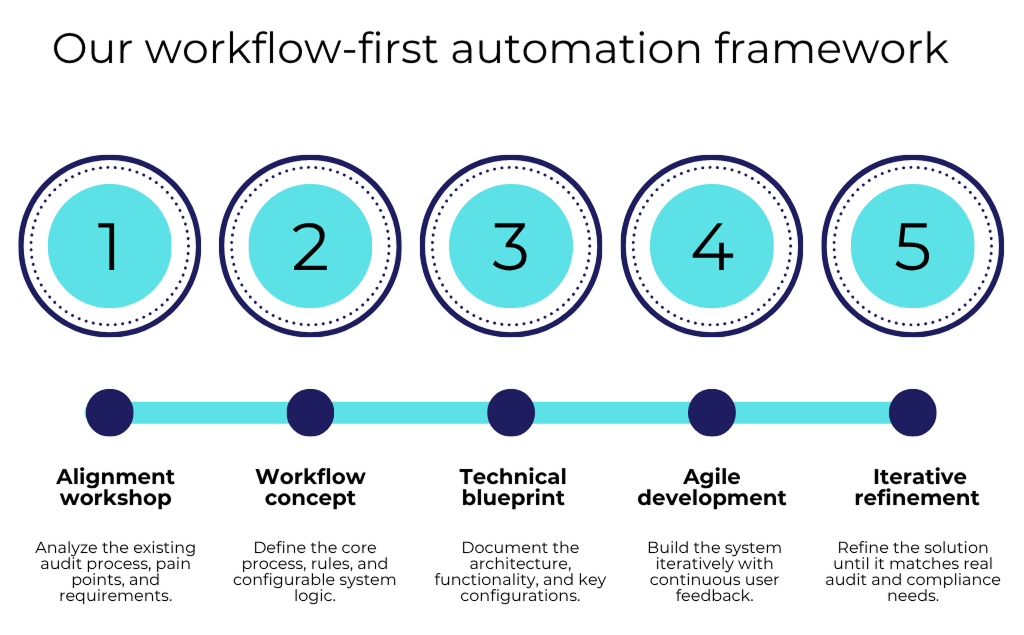
But these steps alone don't guarantee the outcome. You can't design a rule-based system without understanding how accounting works. That's what we do.
Modeso has spent years building software for fintech and regulated industries, which means we come to these projects with the compliance logic and process thinking already in place. We've worked with some of the most prominent players in the financial sector in Switzerland, including TWINT, Würth Financial Services, Visana, Albin Kistler, Aumico, Rietmann & Partner, and more. That domain knowledge is what lets us design the workflow that holds and make sure your product goes live without hiccups:
We build software around your accounting processes. Your team doesn’t have to rely on workarounds or adjust your way of working to fit the system.
We know what regulated environments demand. So from the start, we understand the compliance requirements, audit logic, and practical constraints your team works with.
We connect everything to your existing tools. Your team keeps working as usual, without disruption or messy transitions.
As your business evolves, our solutions can easily adapt and grow with you without rebuilding everything later.
We test the system with the people who will use it before it goes live. And we stick around after in case something needs fixing.
We also know that workflow systems cannot be built with disconnected vendors. It requires a development partner who understands the domain and takes ownership end-to-end. At Modeso, we take this full-cycle approach. We deliver custom software solutions 30% faster than the market average, with 97% client satisfaction rate.
When one team maps the process, another builds tools, and your internal team is fixing whatever breaks in between, it doesn’t work. On paper, the project looks covered from all sides, but no one owns how the system works as a whole.
As a full-cycle software development partner, we take ownership of the entire system from workflow design and system architecture to development, integrations, and long-term evolution. And that's the point, because you can't automate a process in pieces and expect it to work as a whole.
Enough theory, I guess. Here's a real project we delivered for our client.
Automating audit workflows for a Swiss nationwide auditor and tax consultant
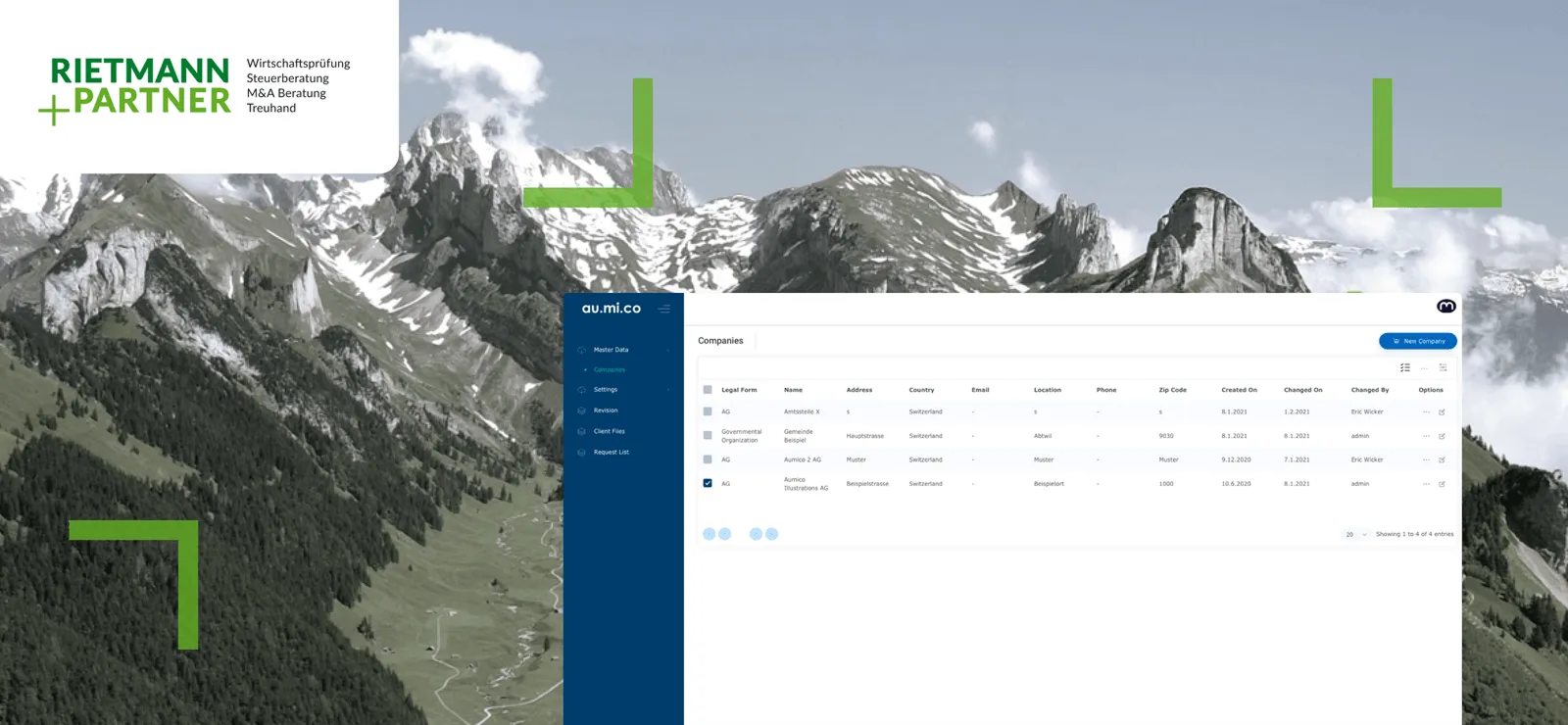
Rietmann & Partner, a Swiss auditing firm established in 1911, faced a problem that many accounting organizations will recognize. Their auditors manually navigated each engagement, exposing the firm to compliance risks. Dissatisfied with the available off-the-shelf audit tools, Rietmann and Partner decided to build a custom solution tailored to their needs. They turned to Modeso to implement this project.
Before diving into development, we had to understand all the intricacies of auditing procedures. The work started with an alignment workshop, where the team looked at how the audit process runs in practice. Based on that, we designed a configurable workflow and turned it into detailed technical documentation that served as the blueprint for development. From there, our team moved into an Agile development process and iteratively refined the system through regular feedback loops.
Instead of automating isolated audit tasks, we built a rule-based audit workflow system. The system guides auditors through each step, enforces validation at every checkpoint, tracks decision logic throughout the process, and generates a reliable audit trail automatically.
The implemented solution streamlined the internal audit workflow and helped our client position itself as a global player.
If you're evaluating accounting automation, the starting point is a question: How does our accounting workflow work? Not how it should work. But how it works today, with all the informal dependencies that hold it together. Have you asked yourself that question?
Here's a quick gut-check before you go any further:
If most of those checklist items don't have a clear answer, your workflow isn't ready to automate. Not a problem at all, it's the starting point.
Modeso helps companies analyze and redesign accounting workflows before writing the first line of code. If your automation isn't working as expected or you're building from scratch, we'd love to help you figure out where to start.

Privacy is important to us, so you have the option of disabling certain types of storage that may not be necessary for the basic functioning of the website. Blocking categories may impact your experience on the website. More information


