
Most conversations about software development cost start in the wrong place. Teams compare the hourly rate of a developer with the cost of a full team. Viewed that way, full-cycle development always looks more expensive.
But this approach misses the mark. It compares coding hours to an entire delivery ecosystem, which covers discovery, architecture, QA, DevOps, compliance, and long-term maintenance.
In reality, you’re not choosing between higher and lower cost. You’re choosing between paying for the full product lifecycle upfront… or overpaying for the consequences later.
In this article, we’ll unpack what full-cycle development costs and why the “cheaper” alternatives often create bigger bills than planned.
Let's compare dedicated teams, in-house development, and full-cycle software development side by side, using a minimum viable product (MVP) scope as the baseline. Let’s start with a dedicated team.
In theory, a dedicated development team is the most rational choice. You hire a team from a vendor, agree on the costs, and retain control internally. For a typical MVP, we're looking at a small team: 2 developers, 1 UI/UX Designer, 1 QA, and a PM. Most MVPs take from 8 to 12 weeks total.
To understand what it costs, let's break down how much time each role requires and what the company charges per hour. The table below outlines the approximate hours per role, along with average hourly rates in the DACH market.
And that’s before accounting for your own time.
And that’s not all.
With a dedicated team, you don’t outsource responsibility. Product discovery, requirements clarity, architectural direction, prioritization decisions, and quality trade-offs all still sit with you. The team builds what you tell them to build, but defining the priorities and controlling the results are your job. Every wrong assumption or late decision adds more billable hours.
When requirements shift (spoiler: they always do at the MVP stage), the meter keeps running. You pay for execution time, not for outcomes. And uncertainty is billed by the hour. Mind, this is only a baseline estimate. In most cases, the final cost trends above this range.
Hiring internally feels like the safest option. You build your own team investing in long-term capability. For established products, that logic makes sense. For an MVP, it doesn’t. Here's why.
Building an in-house team starts with recruitment. You need to find, interview, and hire the right people, which takes months. Then come competitive salaries, onboarding time, management attention, and setting up processes that don’t yet exist.
To make the comparison fair, let’s assume the same setup as with a dedicated team: 2 developers, 1 UI/UX Designer, 1 QA, and a PM. According the SwissDevJobs, IT specialists in Switzerland earn around €9,000/month on average. That's €45,000 per month in salaries alone before taxes, benefits, equipment, software licenses, or office space. Over three months, you're looking at €135,000 minimum.
But in-house teams don't start coding the day you hire them. Onboarding takes weeks as they need to understand your business and align on processes. You pay salaries during that ramp-up period with zero output. So, for an MVP, this model frontloads massive costs before you've validated anything.
A full-cycle MVP might also take from 8 to 12 weeks using fixed-scope or milestone-based pricing. In this case, you don’t count heads or track hours. A full-cycle partner takes ownership of the entire process, including scope shaping, architectural decisions, trade-offs, delivery, documentation, and handover. When they own the outcome, they absorb the cost of delays and pivots. You don't.
In plain language, if there's costly rework because of a wrong architecture decision, you don't pay extra. That's built into their commitment. They quoted a price to deliver a working MVP, and overruns are their problem to manage.
This shifts the economics. You don’t pay for a) billable inefficiency from scope changes, b) idle time when the project hits natural pauses for feedback, and c) infrastructure overhead like recruitment, onboarding, or process development.
You pay for delivery, which eventually costs less than a dedicated team. And carries significantly lower risk than building an in-house team from scratch. Here’s how it looks in brief:
Dedicated team vs in-house vs full-cycle development
Comparing various pricing models, we've assumed everything goes according to the plan. But when budgets are tight or timelines are aggressive, teams start cutting corners, compressing discovery, rushing architecture decisions, or skipping proper QA. Those shortcuts feel like savings at first. But they're just deferred costs that show up later as expensive rework.
Proper product development follows a predictable set of phases. Each one exists to catch issues while they're still addressable. Full-cycle development usually includes business analysis, UX/UI design, architecture, development, QA, and ongoing support.
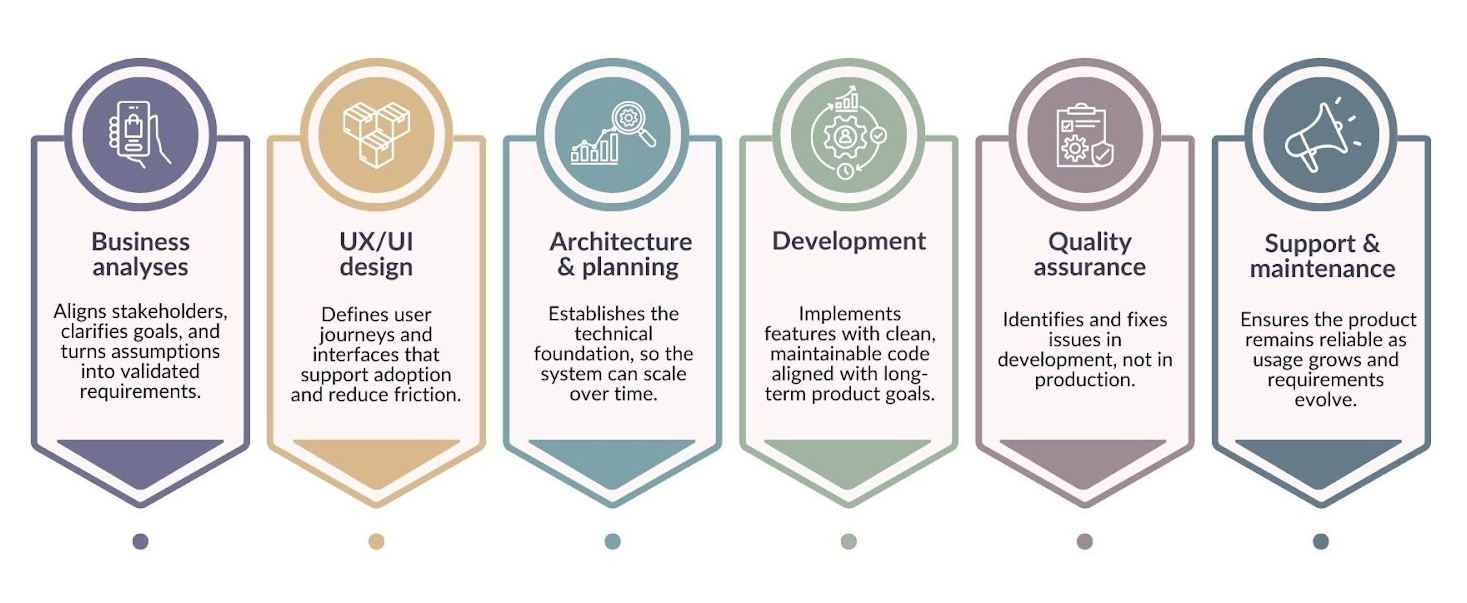
If any of these components are missing, the cost doesn’t disappear. It piles up for the future, where it becomes more expensive and more urgent to fix. Here’s what that looks like in practice:
According to the BCG survey of global C-suite executives, more than 30% of technology development projects are late or over budget due to misalignment between business and IT on operational objectives, unrealistic timelines, and insufficient resourcing. But these issues point to a deeper structural problem: unclear ownership. Let's get specific about how that increases costs.
Split responsibility means nobody catches problems early. Issues surface late in development or after launch, when fixing them costs 5-10x more. Here's where that shows up most often.
Requirements almost always evolve during a project. When no one owns this process, those changes turn into scope creep, which adds cost on top of the original budget.
To “save time,” teams often skip proper business analysis or rush discovery. The result is features that look right but don’t work in practice and need rebuilding.
Phrases like “we’ll figure out the architecture as we go” usually appear when no one owns long-term technical decisions. Problems then show up later, when traffic grows, or systems integrate. By that point, small fixes become expensive rewrites.
It’s not always the case, but testing is sometimes pushed toward the end of the project. When that happens, bugs slip into production, leading to urgent fixes and downtime. These unplanned interventions might increase costs after development was expected to be complete.
In other words, projects derail when your development team is incapable of taking ownership of your project. And numerous examples prove it.
HealthCare.gov is a well-known example of what happens when project phases are compressed. The website was launched on October 1, 2013, and almost instantly, it failed. It was the digital backbone of the Affordable Care Act, allowing Americans to compare plans, qualify for subsidies, and enroll in health insurance.
Within hours after launch, HealthCare.gov became unusable. Pages froze, users couldn’t log in, and error messages multiplied. While early reports blamed traffic, later investigations showed that the load wasn’t the real issue. The root causes were structural. Teams rushed discovery, architecture decisions followed political deadlines rather than readiness, and responsibility was split across vendors with no owner.
The consequences were expensive. Costs ballooned from an initial $93.7 million to an estimated $1.7 billion before the platform stabilized. HealthCare.gov recovered, but it’s a reminder that rushed phases come back as expensive fixes.
If rushing costs that much, what does the proper approach cost?
It’s hard to give a universal number for full-cycle development, and any company that claims otherwise is oversimplifying. But we can understand the factors that shape that cost.
Each of the factors below increases delivery effort and risk in a different way. In full-cycle development, they are priced upfront to avoid surprises later.
The number of features, user roles, integrations, and technical requirements impacts development time. For example, a simple marketplace with basic listings costs less than one with AI-powered real-time matching and analytics.
A templated interface with standard components is one price point. A fully custom design system with animations and responsive layouts across devices is another. So, the price jump between them might be significant.
Requirements like real-time processing, complex data structures, or third-party integrations add architectural complexity. If you need the system to scale from day one, that architectural foundation costs more upfront than a simple MVP structure.
GDPR compliance, payment processing standards (PCI DSS), healthcare regulations (HIPAA), or financial services requirements demand extra effort. And these aren't optional. If your industry or user base requires them, they're part of the baseline cost.
Full-cycle includes a defined support period with bug fixes, minor adjustments, documentation, and knowledge transfer. The length and depth of this support phase affect the total cost. Some products require ongoing optimization and iteration, while others need a stable handover. That commitment is priced into the full-cycle package.
To sum up, costs depend on project complexity, integration needs, compliance requirements, and dozens of other factors. And of course, pricing varies from vendor to vendor.
We can’t speak for others, but we can show you how full-cycle works at Modeso. Our full-cycle approach follows four connected phases: Alignment & Discovery, UX/UI Design, Development (including QA and DevOps), and Maintenance & Growth. Each one builds on the last to protect the investment you’ve already made.
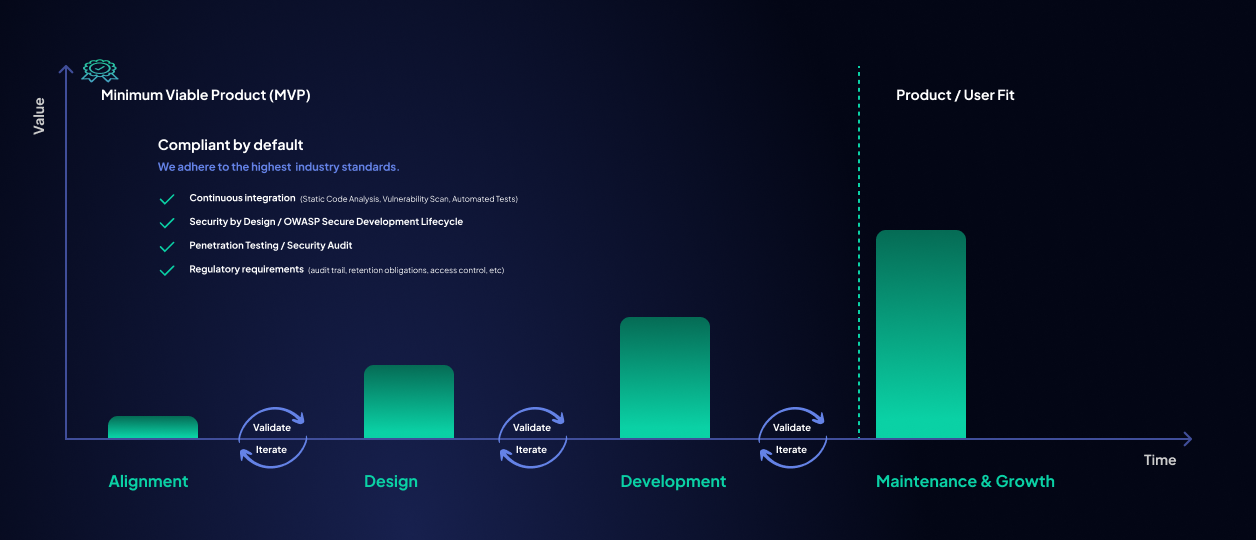
To illustrate how it works, let's break down a standard enterprise application and show you the investment at each stage.
A basic enterprise application has a focused scope, limited integrations, and predictable workflows. Here’s how we approach the budget for such projects at Modeso.
Phase 1: Alignment & Discovery ~15–20% of the project cost
This phase aligns all stakeholders. We run requirements workshops, validate user journeys, identify compliance or operational constraints, and assess technical feasibility. By the end of this stage, the team has a clear scope, timeline, and roadmap.
What’s included ↓
→ Requirements workshops with stakeholders
→ Validation of user journeys and operational workflows
→ Identification of edge cases and compliance constraints
→ Initial technical assessment and feasibility
→ Clear scope, timeline, and roadmap
How we reduce the cost at this stage ↓
Every unclear decision avoided here saves weeks of rework later.
Phase 2: UX/UI Design ~15% of the project cost
Here, we translate the agreed requirements into tangible user experiences. We map user journeys, create wireframes, design core interface screens, and more.
What’s included ↓
→ User journey mapping
→ Low-fidelity wireframes
→ High-fidelity UI screens for core flows
→ Design system foundations
→ Clickable prototype for early feedback
How we reduce the cost at this stage ↓
Pragmatic design reduces development effort and prevents costly redesigns.
Phase 3: Development (incl. QA & DevOps) ~ 45–55% of the project cost
Development covers frontend and backend implementation, along with the core feature set and required integrations. We provide clear technical documentation for easy handover and future changes.
What’s included ↓
→ Frontend & backend development
→ Core feature engineering
→ Basic role/permission model
→ API integrations
→ QA testing across all major flows
→ CI/CD setup for stable deployments
→ Documentation and internal knowledge transfer
How we reduce the cost at this stage ↓
Most cost overruns happen here. Yet, our clients see up to 80% fewer bugs and far fewer late-stage surprises through comprehensive testing and quality processes.
Phase 4: Maintenance & Growth (for 6 months) ~ 10–15% of the project cost
After launch, we stay close. We fix bugs, smooth out performance, and add small enhancements as real users begin interacting with the product. Behind the scenes, we monitor the system and handle compliance updates.
What’s included ↓
→ Bug fixes and performance improvements
→ Minor enhancements based on early user feedback
→ Monitoring and support
→ Compliance updates if needed
How we reduce the cost at this stage ↓
Post-launch surprises are expected. Planning for them up front is cheaper than reacting later.
Now, let’s see how it looks in real projects.
Below are examples of full-cycle projects we commonly deliver, along with approximate budget.
If you weigh all pros and cons, full-cycle development does not cost more than dedicated or in-house team. It exposes the real cost upfront, so you don’t pay for it twice. If you want predictability, lower long-term cost, and a partner who takes responsibility for outcomes, full-cycle is the model designed to deliver it.
At Modeso, we follow a full-cycle development methodology built around four core principles:
1. Swiss-based product ownership
Our product owners are in Zurich, so they do more than schedule meetings. They meet your team in person, speak your language, and understand your constraints.
2. End-to-end responsibility
Our developers, QA engineers, and DevOps specialists handle architecture, implementation, testing, deployment, and documentation under one roof. And we take full responsibility for the outcome.
3. Accelerated time-to-market
We deliver 30% faster with Swiss-quality standards and lean development methodology. Clients regularly see shorter release cycles, fewer defects, and faster scaling, which makes every iteration less expensive.
4. Built-in DACH compliance and enterprise-grade governance
Compliance is not an optional layer added at the end. We design for GDPR, FADP, auditability, and data protection from the start.
From the first alignment workshop in Zurich to scaling your platform in production, our goal is to deliver enterprise-grade software at competitive prices.

Privacy is important to us, so you have the option of disabling certain types of storage that may not be necessary for the basic functioning of the website. Blocking categories may impact your experience on the website. More information


