
Data sits at the heart of every modern software product. Transactions, customer journeys, reporting, automation, and AI-driven features all depend on reliable data. But when data projects fail, the problem is rarely the data itself. Most failures come from poor data management, which slows delivery and drives costly rework.
After over a decade of building data-heavy systems, we see these issues most often in fintech and healthcare. And it’s not because these industries use more data or require more complex data management techniques. They simply can’t hide data mistakes for long. What might be dismissed as technical debt in other sectors quickly becomes compliance violations in finance and patient safety risks in healthcare. That’s why in this article we'll focus on the examples from these two domains.
Below are the most common data management problems we encounter in our work. For each problem, we explain what breaks, why teams miss it, and how we build systems that avoid these failures from the first sprint.
This is one of the most common data management issues that starts quietly. Normally, a product is built, it works, and then integrations follow. First the CRM, then the ERP, then payments or reporting tools. Each integration becomes a separate project, often handled by a different vendor. Integrations follow different patterns, and documentation lives in separate places. Consequently, when something breaks, no one knows who’s responsible.
System integration should never be an afterthought. It should be a part of full-cycle development where one team is responsible for data models and APIs from day one.
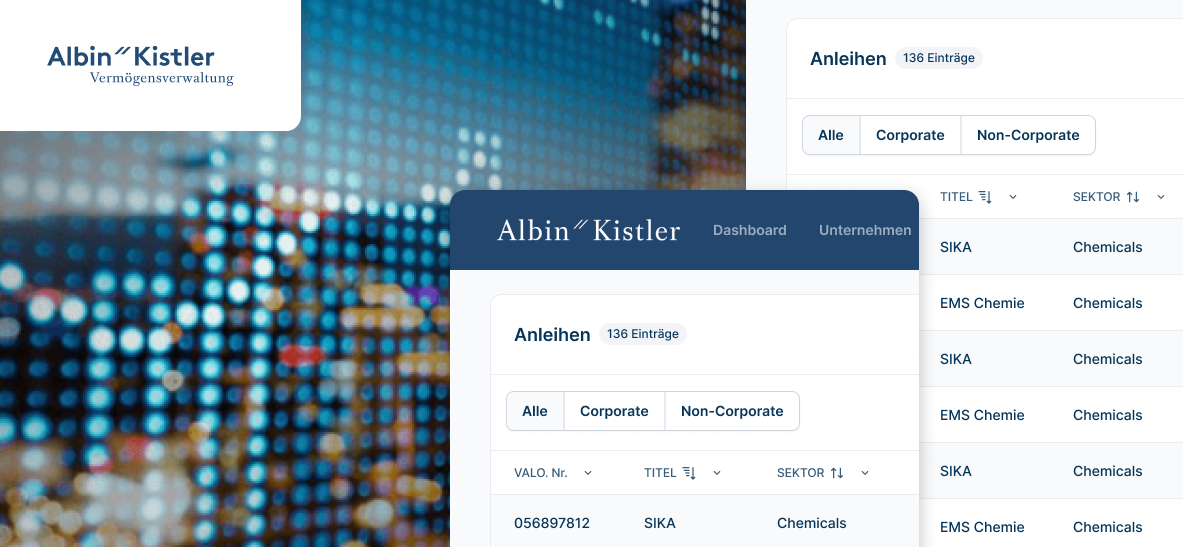
A good example of how it worked is our client Albin Kistler. It’s a Swiss asset management company serving private and institutional clients. Their investment platform was running on an old research database that started holding them back. When we modernized the platform, we built all integrations directly into the core system. It created consistent data flows across all connected systems and made the platform easier to maintain.
Data quality is crucial for every system. However, many organizations still operate with data that lives in different formats and contains missing fields. The problem becomes clear if companies decide to build AI on that data foundation.
It usually looks like this. Teams pick models, evaluate vendors, run pilots, build prototypes, and only then discover that AI produces unreliable results. And start blaming the algorithm. But AI success doesn't start with algorithms. It starts with data readiness.
Before investing in AI capabilities, you need to address the fundamentals. Clean and validate data at entry points, standardize formats, secure sensitive information, and make data interoperable using industry standards like HL7 for healthcare or ISO 20022 for financial services. The model might be state-of-the-art, but if trained on incomplete patient records or inconsistent transaction data, results will be unreliable at best and dangerous at worst.
Many companies think about data twice: when it’s created and when someone needs a report. Everything in between gets ignored. As systems grow, teams keep copying, reshaping and moving data across tools until no one can say with confidence where it lives.
That’s the moment data turns from an asset into a headache.
To keep data under control, companies need end-to-end data lifecycle management (DLM). It defines clear rules for how data is used, stored, and removed from the outset. In plain terms, data can’t drift freely across systems. This approach helps avoid compliance violations, security risks, and the uncomfortable realization that sensitive data from years ago is still hanging around for no good reason.
In fintech and healthcare industries, security is paramount. Encryption, access control, audit logs, and compliance reporting are part of the baseline. However, teams might take security as something that slows development down. But it happens only when security is added after the product is already built. In such a setup, every new feature creates friction, and engineers have to choose between speed and compliance.
Security needs to be designed into the architecture before development starts. That means defining access control models, data isolation boundaries, and audit requirements during the planning phase. Then security scales as the product matures.
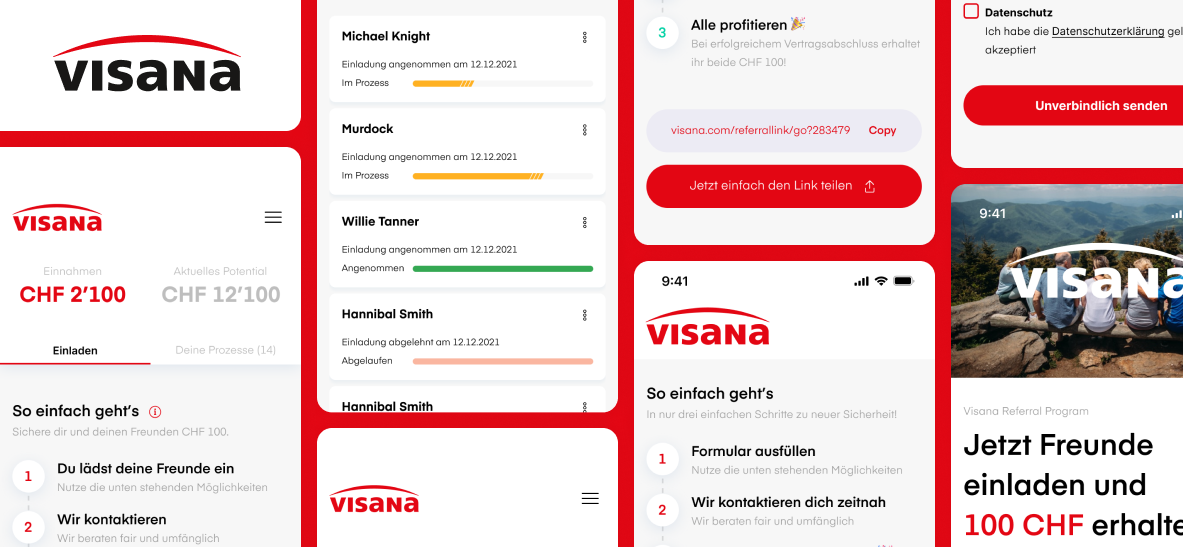
At Modeso, we always look for an optimal solution to align security and delivery. With Visana, a Swiss health insurance provider, the task was to launch an MVP for a referral program quickly without putting sensitive data at risk. The MVP ran as an in-app browser inside Visana’s mobile app, but integrating directly with the core insurance systems would have added unnecessary security overhead.
To move fast without cutting corners, we deliberately avoided a direct API integration. We implemented a secure, file-based integration with scheduled data transfers. This allowed Visana to exchange only the required data in a controlled way and keep the core systems isolated.
Many data management challenges trace back to data fragmentation. Systems grow, teams multiply, and each team focuses on shipping their features quickly. They store data in whatever format suits their needs. Later, integrations get added as quick fixes, often by yet another team. As an outcome, fragmentation becomes baked into the system.
For fintech, this means customer profiles sit in one system, transactions in another, and compliance data somewhere else. The same goes for healthcare. Patient data is spread across tools for appointments, medical history, and billing. Nothing is lost. But no one is responsible for keeping the full picture intact. Without clear ownership, data quality slowly erodes, and teams work with whatever slice they can access.
Fragmentation is preventable, but it requires upfront decisions. You need to establish canonical sources early: this system owns customer data, that one owns transactions, and another handles compliance. Then you build integrations that reference these sources instead of copying data locally. When one team has the keys to data architecture and integrations, consistency is easy to keep.
Scalability constraints don’t show up in the early stages. When data volumes grow, however, the system begins to push back. Performance drops, infrastructure costs rise, and even small changes feel heavier than they should.
Nothing is surprising about this. It’s the natural outcome of a data architecture that was never designed to scale. The product still runs, but scaling works against the existing architecture.
Unfortunately, there’s no quick fix once you get here. You can’t patch scalability when you need it, as it has to be designed in from the start. You need a team that makes deliberate choices around data storage early and takes responsibility for how the system will grow over time.
At Modeso, we treat scalability as an architectural responsibility. During discovery and early design, we look beyond current data volumes and define how the system is expected to evolve over time, like which trade-offs are acceptable now versus later, and more. This way, we build software solutions where growth doesn’t automatically translate into rising costs and degraded performance.
Data migration challenge arises when a company moves to new software, upgrades existing systems, or undergoes a structural shift. On paper, it sounds simple: move data from point A to point B. In reality, you have to make sure data arrives accurate, consistent, and usable in the new system.
The best strategy here is building a comprehensive migration plan and executing it step by step, with continuous validation at every stage.
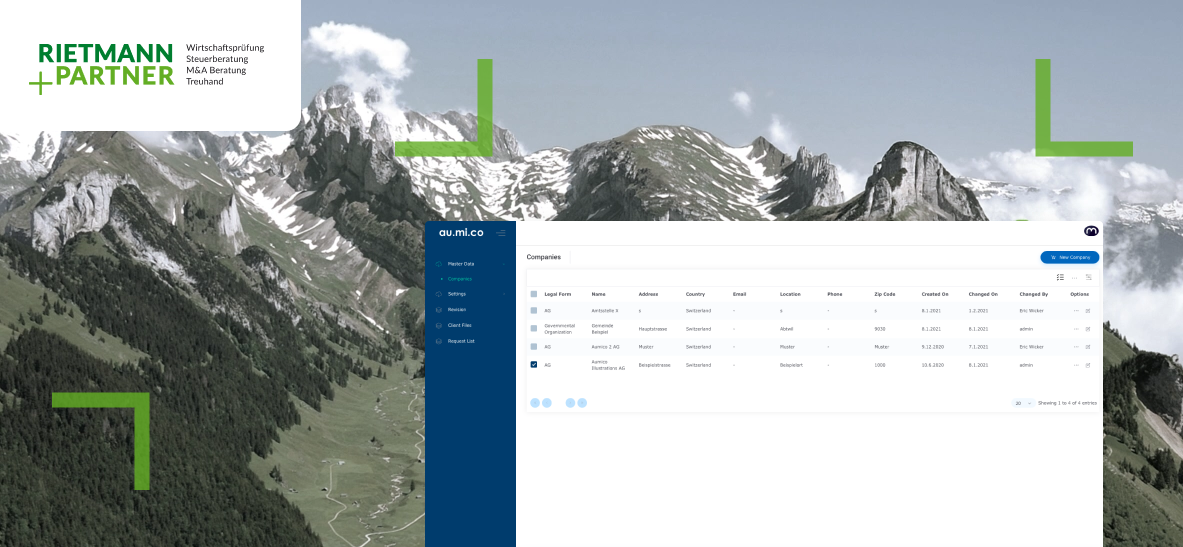
We applied this approach with Rietmann and Partner, a Swiss nationwide auditor and tax consultant with over 100 years of history. They needed to simplify internal workflows and automate their audit process, but years of audit work lived in Excel files. The key challenge was migrating that data into a new, rule-based platform without disrupting ongoing audits.
Together with the client, we analyzed the Excel-based structure, mapped it to the new system, and built validation checks directly into the import process. It ensured a smooth transition without data loss and preserved the integrity of historical audit data.
When you ask five people how data moves through their company, you'll get five different answers. Without shared processes and documented workflows, data management turns into improvisation. Teams use whatever tools feel convenient and no one can explain how information flows through the organization. In healthcare, where data volumes are huge, this becomes a problem companies can’t afford to ignore.
The solution is structural. Centralize workflows into a single system where data moves through outlined stages with clear ownership at each step. When these flows are encoded into the system, teams don’t rely on personal habits or tribal knowledge to keep data in sync.
We saw this firsthand with Dental Axess, a global integrator of CAD/CAM and dental imaging solutions for dental clinics and laboratories. Before working with Modeso, critical data moved through emails, Dropbox, and Google Drive. It often fell out of sync, leading to delays, rework, and unnecessary manual checks.
Together with Dental Axess, we built Xflow, a cloud-based platform that brings the entire clear aligner manufacturing process into one system. Patient data, scans, and production steps now live in a single, structured workflow. Each stage is defined, responsibilities are visible, and data stays consistent from initial scan to final production.

Today, data management tools and technologies evolve faster than humans can follow. As a result, there is a gap between what the business needs from its data and what the team can deliver.
To overcome this challenge, companies can try several strategies:
Regular training helps your team stay confident as data tools advance. Focus on practical skills, like data modeling, quality validation, security practices, and pipeline design. When your team understands the full data lifecycle, they can maintain and extend systems with less reliance on external help.
If you lack in-house data expertise and training is not an option, outsourcing makes sense. External partners with niche expertise in data management systems provide targeted support and help you solve data management needs faster. At Modeso, we help you build data-driven systems with full-cycle ownership from architecture to deployment.
Implementing user-friendly data management tools helps your non-technical staff handle routine data tasks. Clear interfaces and guided workflows make data management more accessible and free up data experts for more complex work.
As products grow, ownership naturally spreads across teams. One team looks after customer accounts, another focuses on transactions, and a third builds reports and dashboards. That’s normal. The trouble starts when there’s no shared set of rules for the data inside.
Without unified data governance, each team defines core concepts in its own way. One service marks a customer as "active" if they logged in this month, another considers them "active" if they made a purchase this year, and a third system calls them "active" because the account exists. All three are reasonable in isolation and completely confusing together. As a result, teams argue over numbers, and data doesn’t seem reliable anymore.
From our experience, governance needs to be embedded into the product at the architecture level. When it is, teams move faster because data standards are set and data behaves the same way everywhere.
So yes, data management is complicated. But these problems don't have to be yours.
While the challenges we listed look different at first glance, in most cases, the cause is the same: no one owns data from start to finish.
That’s why quick fixes won’t help. Adding a few validation rules or swapping one tool for another might calm things down for a while. But as soon as the system grows, the same issues resurface. The only way out is to start thinking about data early.
Here’s how we approach data architecture at Modeso:
Before development begins, we map out how systems will connect, what data formats they'll use, and where the source of truth lives.
We document how information moves from entry to storage to analysis. Validation rules, error handling, and monitoring are designed in from the beginning.
We create standardized patterns for ingestion, transformation, and synchronization. This makes systems easier to extend and maintain as they grow.
When the same team owns architecture decisions, implementation, testing, deployment, and ongoing maintenance, data quality becomes part of the product. We've fixed enough broken systems to admit this approach works.
Data management is a foundation you either get right from the start or pay for over time. So treat data architecture and governance as core parts of full-cycle software development. Being a software development company that's been helping DACH companies build systems that scale and remain maintainable for years, Modeso can help you keep your data in order.

Privacy is important to us, so you have the option of disabling certain types of storage that may not be necessary for the basic functioning of the website. Blocking categories may impact your experience on the website. More information


